
Student Life
Living on borrowed time: Oxford’s journalism

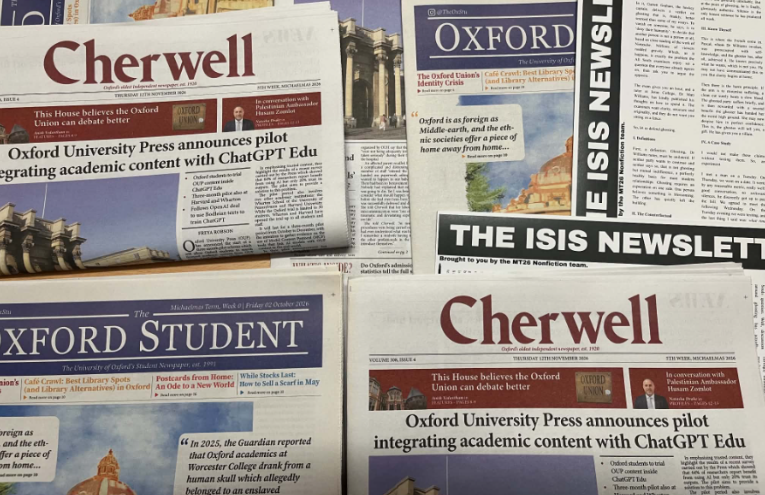
When Alexander Görlach, former publisher and Editor-in-Chief of The European Magazine, asked the crowd of Media Society attendees when they last picked up a printed newspaper, it was clear he expected an answer like his own: not for years. This would hammer home the trepidation that dominated his discussion about the future of modern, online journalism. But the contrasting response, a mix of chuckles and shrugs followed by “well, the last Cherwell, obviously”, seemed to jar after the laughter had died out. It’s clear that the journalism we have here in Oxford, a thriving, near-saturated print culture, and the journalism Görlach diplomatically discouraged us all from pursuing aren’t just slightly different, but incomparable – the word can’t possibly cover both.
Even after only a few weeks in Oxford, I’ve felt the palpable hold of student publications over this University, whether at bustling launch events at pubs across the city or unwavering recruitment drives at the Freshers’ Fair, more determined than any other society. Writing and reading about relevant issues both globally and locally is a key part of building this academic community, so it’s easy to adopt a rose-tinted view of what it means to be a journalist outside of the Oxford bubble. There is everything admirable but nothing realistic about our steadfast intention to educate each other about what goes on outside college walls.
So, if we want to pinpoint this dissimilarity, that word ‘intention’ is where I would start, as it’s precisely what is contorted in the digitised world of media that Görlach knows all too well. The multiplicity of sites, papers, and journals now readily available means it’s no longer possible (if it ever has been) to attempt to read a neutral perspective; you must, as Görlach implied, become almost mercenary with your intentions when seeking out material. He noted that the political orientation of a source comes second to the standards he wants to hold himself to in terms of quality of writing, citing his loyalty to The Economist as an example, but added that when he needed “cheering up”, he would turn to The Guardian. Such a level of selectiveness even in the day-to-day act of getting the morning headlines would have been unimaginable in a pre-digital age and is still an alien concept to our more inclusive culture of student journalism. The question of intention can equally lead to the opposite extreme – the majority of people do not ponder what they consume to the extent of Görlach, and rely on what the Reuters Institute labels “incidental exposure”, being entirely at the mercy of external companies, predominantly social media outlets, to deliver pieces of journalism at well-timed intervals on their feeds. The role of the journalist is, at both ends of the spectrum, at the mercy of whim, whether this is of the algorithm or the academic. Simultaneously, even the most established papers cease to be viewed as organisms by everyone but their most committed followers, turning into a variety of Instagram thumbnails and the regular voices of one or two particularly enigmatic commentators.
But it would be naive to claim that the decline of coherent media is purely the fault of technologicalisation – the call is also coming from inside the house. It’s no secret that journalistic principles have never truly applied to the senior money-wielders behind the tabloids, yet there have been recent instances where the relationship between the article and its financier has become paradoxical. For example, while we might not expect, or want, objectivity from a journalist, every release from a publication under the Polish media group Polska Press is automatically inextricable from its recent owner, state-run oil firm Orlen – the company echoes the ruling party’s intention to “repolonise the media”, leading to concerns for Poland’s media pluralism, a key characteristic of modern journalism. The gradual subsumption of countless local papers into a nationwide political drive is hardly something that can be shrugged off when doing the crossword, let alone reading the opinion pages.
With this in mind, if the only current sign of cohesion in newspapers or other bodies of journalism is their commercial and strategic utility, will we ever reclaim a media that prioritises informing? Yet we have been forced to ask this question on a far greater scale, since the role of the journalist as gatherer, fact-checker, and reporter has expanded in conflict zones (most recently in Ukraine and Gaza) to include sacrifice. Watching journalists lose their lives for their stories makes us wonder whether there is indeed a difference between a journalist and an activist – a comparison that feels almost shameful versus the low-stakes reporting done from our Cherwell-shaped ivory towers. Görlach pushes for these titles to be kept very separate, however, not because journalism should be apolitical, but because it should be undiluted in its purpose of providing information.
Nevertheless, this conclusion doesn’t take into account the fact that knowledge, especially in crisis zones, is a coveted luxury; losing it is an experience few of us will ever understand. Maybe we call a journalist one who recognises the sheer value of knowing things, of understanding them, purely because they have experienced unwanted ignorance.
It feels a little ironic that my first contribution to Cherwell might seem to threaten the justification of its existence, but in some ways I start as I mean to go on. The parameters of our humility here in Oxford shouldn’t be limited to the financial or academic, but expand into the social and journalistic. While the freedom and fluidity of our paper culture are welcomed with open arms, it wouldn’t hurt to look up from your pitch or commission every now and then to question where our journalism is taking us.
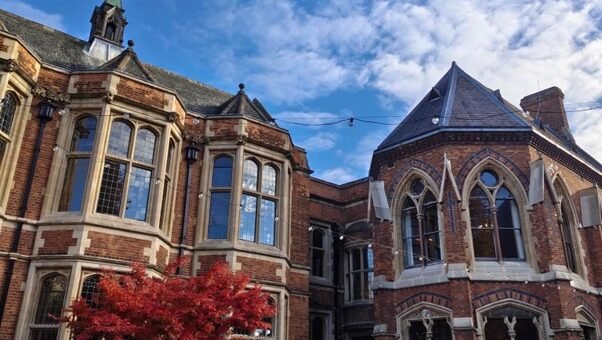
Harry Aldridge has been elected Oxford Union President for Trinity Term 2027, winning 572 first preference votes. The third-year New College PPE student and Union Librarian defeated Union Secretary Saara Lunawat, who received 433 first preference votes.
Sambhav Jain was elected as Librarian in Trinity winning 551 first preference votes. Aarush Yendamuri was elected as Treasurer in Trinity winning 545 first preference votes. George Christiansen was elected as next term’s Secretary winning 554 first preference votes.
Running for the #JOY slate, his campaign focused on “Bring[ing] back the fun” with a Minecraft-themed ball and affordable socials. He also pledged to “put debating first”, “end hack culture” and increase access to the Union so students from non-typical Oxford backgrounds feel welcome.
Aldridge’s election caps an extraordinary Oxford run that has seen him serve as New College JCR President (a role which he was ousted from in a vote of no confidence), President of The 93% Club, Co-Chair of the Oxford Labour Club, and President of Media Society, alongside his roles as the Union’s Librarian and Secretary.
After his election, Aldridge told Cherwell: “It’s an absolutely huge honour to be elected President of the Oxford Union, and I’m so grateful to every member who voted for #JOY. I’ve been completely blown away by the huge amount of support we’ve received, and I could not be more proud of this amazing team. I can’t wait to deliver a fantastic Trinity term: more debating, more fun, and a Union that feels like home for everyone!”
Turnout was notably lower than last year. With 1,095 votes, compared to 1,520 in the Michaelmas 2025 election.
This election was the first run under new voting rules requiring Union members voting to display their union card alongside another form of identification. The rules were instituted after the last two end-of-term elections were affected by voter fraud scandals. In Trinity, results were delayed by a month, and the Union’s disciplinary committee concluded that over 10% of votes were fraudulent.
The following candidates were elected to the Standing Committee, from highest to lowest order of votes: Yolanda Liu, Akheel Kale, Thomas Tadesse, Leyton Styles, Aarav Desai and Victor Marroquin-Merino
The secretary’s committee counts are still being tallied because of the large number of candidates and will be released on Sunday.
When he becomes president in Trinity, Aldridge will take over from Hilary’s President Milo Donovan. In a pre-election interview with Cherwell, Aldridge said his two dream speakers for the term were former Prime Minister of New Zealand Jacinda Ardern and Dance Moms star Cathy Nesbitt-Stein. His dream debate motion for the term is: ‘This house would abolish grammar schools.’
Student Life
‘A great head of hair with a strong last name’: Justin Trudeau celebrates Oxford Fellowship
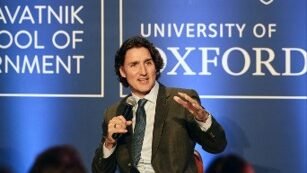
Former Canadian Prime Minister, Justin Trudeau, gave his first public appearance at the University of Oxford since he became a distinguished Fellow. Trudeau appeared in conversation with Ngaire Woods, Dean of the Blavatnik School of Government (BSG).
Trudeau touched on the importance of story telling, compromise in government, and being continually underestimated as a “great head of hair with a strong last name”.
Earlier this month, Trudeau joined the BSG’s World Leaders Circle, a forum to “exchange ideas and foster international collaboration among leaders”.
Trudeau will join the ranks of Rishi Sunak and Jacinda Ardern in the Circle, which is made up exclusively of former heads of government.
Woods told Cherwell that Trudeau “brings with him a wealth of experience, forged through a decade of public service”.
Trudeau helped bring Canada’s Liberal Party from a third party to majority government in 2015. Major moments in his premiership include signing the Paris Climate Accords, introducing the Canada Child Benefit and a trade war with the United States, which he responded to with a 25 per cent tariff on $30 billion of US goods.
He resigned in 2025 following a steady decline in popular support and the resignation of the deputy Prime Minister, Chrystia Freeland. Freeland is now the CEO of the Rhodes Trust.
He has made headlines recently due to his relationship with pop star Katy Perry.
The BSG opened in 2012 thanks to a £75 million donation from oligarch Len Blavatnik. It aims to “inspire and support better government and public policy around the world”.
Oxford’s Canada Society told Cherwell their members were excited over the growing list of high-ranking Canadians with connections to the University. Trudeau’s ex-deputy Prime Minister Christia Freeland was appointed as CEO of Rhodes Trust in July. Current Canadian Prime Minister Mark Carney also earned an MPhil and DPhil in Economics at Oxford between 1991-1995.
Trudeau’s appointment is a “great opportunity for our members to meet and speak informally with the former Prime Minister”, the society said.
Cherwell understands members of Canada Society were invited to an informal meeting with Trudeau earlier this week.
The conversation on Monday started with a discussion about compromises in government. Trudeau challenged the idea that compromise is a negative, arguing that his decision to work with Canada’s New Democratic Party in his third term created Canada’s longest running minority parliament and “allowed us to do a lot of big things”.
He added that compromise was not a one-off but the business of government, as “the easy decisions have all been taken”.
When asked about the importance of storytelling in politics, Trudeau said that while many of his peers were studying political science, he chose to study English Literature at McGill University in Montreal.
“It seemed to be the best path to choose that had the lowest chance of forcing me to have to get a job immediately after graduation”, Trudeau said.
He told the audience that he used his degree by storytelling every day as prime minister, adding “the winner in an election is just the person who tells the best story.”
Trudeau pointed to the narrative he built regarding Canadian sovereignty, which left “the maple syrup MAGA opponent of the Conservative Party in a very, very awkward position”, in apparent reference to Piere Poilievre, leader of the opposition CPC party.
At the time of Trudeau’s departure his Liberal party trailed in the polls by over 25%.
An audience member asked him about the recent presence of Nathan Cofnas at Oxford and the challenge of distinguishing free speech from hate speech. Cofnas, a self described “race realist” who publicly raised plagiarism accusations against Professor Jason Arday, Cambridge University’s youngest Black professor, was invited by Oxon Universities’ Reform Society to speak to Oriel College earlier this month. The talk went ahead despite hundreds protesting outside the college.
Trudeau replied that “places like universities are supposed to be challenging”, adding that they are “supposed to have people making arguments that are completely wrong so that others can deconstruct them”.
He said that while he would never defend “‘horrific and vile speech”, the alternative of driving these arguments underground could be worse, creating polarisation.
He warned against progressives being “dragged into wedge politics issues” which represent “distractions to feed the algorithms” and do not help people on the ground.
The conversation turned to the Canadian’s celebrity-like status and good looks, and whether being an “incredibly handsome politician” is a constraint or advantage. He said that the media narrative that he was “a great head of hair with a strong last name” meant he was underestimated in every electoral contest for which he stood as candidate. “They wrote me off every time”, he said, including for his 2012 boxing match against Canadian Senator Patrick Brazeau, which he won.
He added that attention to his appearance has helped him understand how “incredibly misogynistic and difficult” it is for women to run for office, pointing to his 50 per cent gender balanced cabinet and his ‘Ask Her to Run’ campaign.
The campaign involved asking Trudeau’s party’s mailing list if they knew a woman who “would be a great addition to politics” and suggested members encourage her to run, as well as reaching out to women through other channels.
The conversation ended with Trudeau being asked how students can be useful in public service.
“You’re studying here, that’s a great way to go towards politics, but it’s not going to help you going door to door”, he said.
His final piece of advice to students: pick an issue that matters to you and learn how to organise around it.
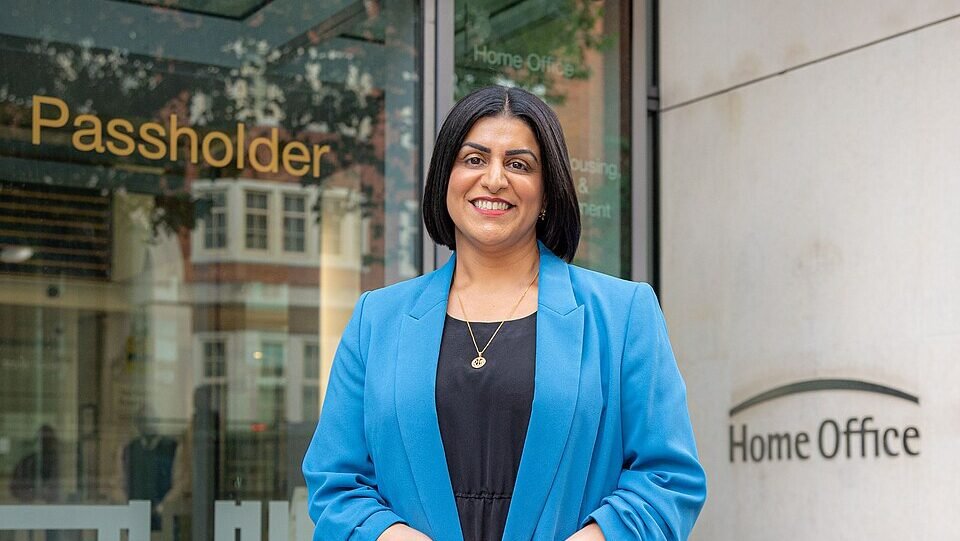
Post-study graduate visas will be extended from 18 months to 2 years for “high-performing institutions”, following a UK government announcement.
The post-study graduate visa allows university students graduating from UK universities to stay and work in the UK after completing their course. In May 2025, the government announced that the visa would be reduced to 18 months; however, the recent change reverses this for “high compliance institutions”. For PhD students, the visa remains 36 months.
It is unclear which universities are included in this category, with officials stating they must be institutions with “strong labour market outcomes”.
The policy leaves Oxford graduate students in limbo, uncertain of whether it will apply to the University. Students applying for visas before January 2027 will receive a two-year visa, whereas those who apply after may only receive 18 months. In an update posted to its website, Oxford University said that it “strongly recommend[s] being prepared to submit an application by 31st December 2026 at the latest, in case further details are not announced in time or there is a delay before the new arrangements come into effect”.
Student representatives have raised concern over the confusion the visa policy may create. The Oxford SU President for Postgraduates, David Quan, told Cherwell: “For postgraduates on one-year courses, the Graduate visa is an important part of planning what comes after Oxford. The Budget said graduates of some universities will keep two years, but not which universities or from when, and every international student deserves to know where they stand.”
Quan added: “Under the current rules, master’s graduates who apply from 1 January will get 18 months. The University has confirmed that as soon as they know the details, they will update the website and communicate with affected students at the appropriate time.”
The visa extension comes amidst a general tightening of immigration rules regarding students. Last year, the government announced a visa brake blocking students from Sudan, Afghanistan, Myanmar, and Sudan from applying for student visas. At the same time, the Home Secretary also increased the time many immigrants must have lived in the UK to qualify for indefinite leave to remain.



-

 Oxford united FC4 weeks ago
Dogs, drones and extra police powers for Oxford United game
-

 Oxford united FC4 weeks ago
LIVE: Barnsley 1-0 Oxford United – Yoganathan puts 10-man Tykes ahead
-

 Oxford united FC4 weeks ago
Oxford United leaders criticised as results hide concerns
-

 Oxford united FC4 weeks ago
Aaron Ramsey explains Brannagan and Brown Oxford United absence
-

 Oxford united FC4 weeks ago
Reading FC boss criticises Oxford United red card appeal timing
-

 Oxford united FC3 weeks ago
Oxford United player ratings in landmark Reading derby win
-

 Oxford united FC3 weeks ago
Aaron Ramsey gives Oxford injury update on Jin-woo, Roosken
-
 Student Life4 weeks ago
A decade worth celebrating: Spiced Roots turns ten