
Student Life
Oxford bridges ‘town and gown’ with guide for local students


The University of Oxford has produced a guide to strengthen the link between the academic institution and local schools.
This resource, Opening Oxford, focuses on what the University can give to local communities, and how the University itself can benefit from interacting with the wider region. In the foreword, Vice-Chancellor Irene Tracey described the University’s commitment to “strengthening the University’s links with our local communities” and “ensuring young people across Oxfordshire can see opportunities in the University, whether that is study, employment, or interest in our cultural assets”. She added that universities “thrive when they are part of the life of their region”.
Within the guide, curriculum-linked workshops, enrichment opportunities, and lectures are recommended to realise the University’s vision. The activities featured are available for primary school students through to those navigating higher education and career choices.
It also emphasises helping educators through teacher development opportunities and classroom resources. Specific programmes and resources, such as a two-week research programme at Oxford University Museum of Natural History for sixth-formers and St Anne’s Super-Curricular club which offers online classes, are recommended for those considering applying to universities, including Oxford. It highlights post-school opportunities at the University, such as work experience, careers, and apprenticeships.
This guide contributes to the University’s 2025-2030 Strategic Plan, which outlines how the University will partner with the local community to “sustain excellence in education and research, extend our impact through innovation, and exercise leadership…for the benefit of society”.
The project also builds on the academic outreach that the University has previously developed. Similar to The Oxford College Twinning Project, it attempts to develop a reciprocal relationship between town and gown in the city.
Pro-Vice Chancellor for External Engagement, Sport, and Community, Professor Alex Betts, acknowledges that available initiatives and outreach are “not always visible or transparent to teachers across Oxfordshire”. In his introduction to the guide, he hopes it will help close the educational attainment gap and ensure Oxford is not viewed by young people as “distant and unrelated to their lives”.
The programme’s aim overall is to make the University “relevant and inspiring to all”, not only to its students.

Oxford University’s BA Jurisprudence (Law) degree is under faculty review following concerns raised by external examiners and echoed by students, about teaching disparities between colleges.
In a 2026 report seen by Cherwell, both examiners outlined concerns about teaching disparities between Oxford colleges that could affect law students in Final Honour School (FHS) examinations. They questioned whether coordination between colleges was adequate and critiqued a “lack of process” in ensuring students are taught in a “roughly consistent way”.
“There seems to me to be a real possibility of unfairness depending on the topics chosen by the individual tutor in the College and the difficulty of individual questions on the paper,” the report said. One examiner suggested that these issues might not be resolved through simply broadening questions on the paper, while another questioned whether action was needed “to ensure a level playing field across the students in the University”.
Speaking to Cherwell, a final year law student described the situation as “problematic” for students. They said: “The faculty just don’t have enough control over what tutors put on their reading list.”
They told Cherwell that there is no set order for law tutors to teach topics. With the faculty reading list sometimes containing 10-12 weeks of content, this forces some students to teach themselves, especially if the topics not chosen by tutors are easier to score highly on in exams.
They also claimed that in rare instances, some tutors will not include mandatory cases on their reading lists. While these are available to find on the faculty reading list, “it’s on you to make sure you’ve been taught correctly”, according to the student.
Another student claimed that, in last year’s Administrative Law exam, finalists at their college were significantly disadvantaged because they were only taught the first eight weeks of content. They told Cherwell that at colleges where tutors were more versed in administrative law, students were taught more content which was less complex and more likely to come up in exams.
Another law student who graduated in 2025 told Cherwell that they found the tailoring of teaching to exams and the quality of essay feedback varied greatly between colleges.
A University spokesperson told Cherwell: “Undergraduate law teaching combines lectures and classes provided by the Faculty with tutorials arranged by individual colleges. While colleges are responsible for their own tutorial provision, we recognise the importance of ensuring that students are appropriately prepared for their examinations, regardless of their college.”
Cherwell understands that the Faculty of Law is currently reviewing the course and its teaching provision in a working group.

A collaboration between scientists at the University of Oxford and Wuhan University has made a major breakthrough in solar energy efficiency.
Researchers found that bismuth sulphide can absorb light strongly without losing the electrical charge it produces, making it a promising material for semiconductors, the part of a solar cell which converts sunlight into energy.
When a semiconductor absorbs sunlight, it uses its energy to free electrons and leaves tiny, positively charged ‘holes’ in their place. To produce electricity, these positive and negative charges must be rapidly harvested before they meet and cancel each other out. However, laws of physics state that a good absorber of light must also be a good emitter, and therefore the semiconductors that absorb light most strongly are also the ones that lose their charges most quickly.
Solar energy research has long been slowed by the difficulty of finding materials that balance semiconductor absorbency and efficiency.
The discovery of bismuth sulphide, published in Nature in October, unlocks a solution. The researchers discovered it has a rare quantum arrangement that allows it to absorb light efficiently while also making it harder for excited electrons and holes to recombine.
Solar energy constitutes only 6% of Britain’s electricity. Primarily because of Chinese investment, 91% of new global solar and wind facilities are cheaper than the cheapest available fossil-fuel power. However, weather, grid infrastructure, and technological limitations have created a firm ceiling on the UK’s solar energy harvesting. This comes as Prime Minister Andy Burnham has announced the launch of a new government body to invest in the national electricity grid, as concerns mount over the durability and capacity of the UK’s energy infrastructure.
The government projects that the solar sector will support 35,000 jobs by 2030. This includes roles within the solar technology company Oxford Photovoltaics, which contributed to the study. The company was founded in 2010 as a spin-out from the University and now claims to be “commercialising the world’s most efficient solar technology to power the next generation of clean energy”.
Solar energy is also expected to play a major role in the government’s plans for an Oxford-Cambridge ‘growth corridor’. A recent report suggests the UK’s premier innovation zone is falling behind its global rivals, as China continues to build as much as 74% of all solar and wind projects worldwide.
This discovery of the bismuth sulphide semiconductor may trigger changes in the renewable energy sector. To do so, however, requires rapid commercial implementation of the technology. Researchers have yet to establish whether the increased energy savings of bismuth sulphide are enough for it to turn a profit.

Everybody who has spent any extended period of time around me will know that I have a strange obsession with RuPaul’s Drag Race. So when I got the chance to interview Flesh – legendary Soho drag queen, Hertford College alumnus, and winner of the most recent season of the UK spin-off of RuPaul’s beloved show – I was first and foremost quite nervous. Seeing Flesh on TV and Instagram is like staring into the sun. Talking to her, however, was like catching up with an old friend. Both in and out of drag, Flesh is beautiful to an almost intimidating point, but I quickly discovered through speaking to her that she is neither standoffish nor unapproachable. She was funny, warm, well-spoken, and intelligent, and over the course of an hour, I got to pick Flesh’s brain about the contradictions of university life, the liberating possibilities of drag, and learning to become the person she always wanted to be.
There is perhaps no better place for a drag queen to reflect on the performance of identity than Oxford. A university where intellectual confidence and carefully cultivated personas are extremely commonplace, Oxford is very theatrical in its own way. Yet for Flesh, her time here was not always a particularly comfortable performance. “I have been a realist on the verge of pessimism for most of my life,” she tells me. It is a surprising admission from someone whose public persona is characterised by glamour and self-assurance. Having been crowned so recently, though, Flesh is now looking towards a future in which, as she puts it, she can start believing in the seemingly impossible. But the journey towards that confidence was considerably less straightforward than the TV persona might suggest.
Before Drag Race, there was Hertford. Flesh studied English at Oxford, although she admits university was not necessarily where she wanted to be. Having discovered drag at just 15, after stumbling across performances by American drag queen Willam on YouTube, she spent several years harbouring what she describes as a “secret obsession”. It was not until she was 19, towards the end of her first year at Oxford, that she began experimenting with makeup and drag herself. She had anticipated the distraction. “I knew, really, that if I gave myself the tools to start learning these things, I would not stop,” she recalls. “So I was like, it will be a distraction from my studies. And I was right. It absolutely was.” Flesh credits Oxford drag collective Hot Mess with giving her her first-ever performing opportunity, as well as inspiring her to reconcile being hardworking and intelligent with being uninhibited and having fun. She recalls attending their Halloween party, which was also her first time going out in drag alone. She describes the performers as some of the most intelligent and hardworking people she knew, who could then get into drag and become completely uninhibited. What she took from interacting with them particularly stuck with me: “I want to be competent, intelligent, hardworking, and also totally uninhibited, almost like everyone thinks you’re the loose cannon, but you’re actually running the whole show.”
Flesh describes her arrival at Oxford as something of an obligation. Having achieved the grades required to secure her place, she remembers opening her A-level results with a sinking feeling. “I was like, I have to go. I have to go because I’ve done it.” The ensuing years were marked by a persistent conflict between academic expectations and her increasingly clear creative ambitions. The pandemic made matters worse. Flesh recalls leaving Oxford during her second year and eventually completing her coursework, dissertation and finals remotely from London. She did not attend her graduation ceremony, and remembers leaving university with considerable guilt about what she felt she had failed to achieve. “I had a lot of shame and guilt by the time I graduated,” she says. “I knew that I just hadn’t given it my all, but that there was nothing left I could give to it.” For a long time, she avoided talking about Oxford altogether, caught between fear of appearing boastful and the feeling that she had not performed as well academically as she should have.
It is an unusually candid reflection from an Oxford alumnus, particularly one whose subsequent success might invite the familiar narrative of the university as a springboard to achievement. Flesh’s experience suggests something that I know I, and many other students, have been grappling with – that a prestigious education does not necessarily provide the answers to what one actually wants to do with one’s life.
Of course, it was through drag that she began to reconcile the different parts of herself. When asked whether Flesh is a character she created or an extension of her own identity, she describes the persona as an aspirational version of herself. She speaks of what she calls “diva worship”: the importance of powerful female figures in giving young queer people models of empowerment and self-expression. “For me at least, drag was a way of acting out that empowerment and therefore experiencing it in a way that I had never been able to just as myself,” she explains. Yet the ultimate ambition was never to keep Flesh and her everyday identity entirely separate. Rather, drag offered a way of developing the confidence to bring them together. “My intention was always: I want to live a life where I’m myself all the time.”
There is something particularly interesting about this idea in the context of Oxford, a place where students are often encouraged to take themselves very seriously. For Flesh, however, drag’s apparent frivolity should not be mistaken for a lack of intellectual or artistic substance. She is quick to challenge the suggestion that drag is somehow less deserving of serious consideration than other art forms. “I think a lot of it actually lies in misogyny,” she argues. “The minute that a lot of people are presented with the image of a woman or femininity in a way that isn’t being sterilised to be taken seriously, they kind of assume that it’s not important or serious or intelligent.” For her, drag’s capacity to combine comedy, glamour, and political messaging is precisely what makes it effective. A serious message, she suggests, can sometimes be more readily received when it is concealed beneath a layer of humour or spectacle. Her understanding of drag’s political potential is also informed by the way it exposes prejudice within queer communities themselves. She speaks candidly about the misogyny, trans misogyny, and misogynoir she has witnessed throughout her career, arguing that experiencing the world through drag has given her a greater appreciation of the vulnerabilities faced by others. “We’re falling at the first hurdle if we aren’t protecting each other,” she says.
This relationship between self-expression and social expectations also informs her recollections of being queer at Oxford. Despite studying alongside queer academics, Flesh remembers feeling reluctant to incorporate her own interests into her university work. She had written one paper on Polari, the gay slang historically associated with queer communities, but wishes she had explored more of her interests academically. “I felt for some reason that it would not be taken seriously,” she says. “In Oxford, as a student, it absolutely felt like there was no room to be expressive.” She recalls deciding, during a particularly difficult period in her second year, to go to Plush in drag with friends. Having heard that other Oxford drag queens sometimes attended to promote their events, she hoped to embrace a more visible version of herself. “I’ve never felt more invisible,” she says. “I remember thinking, people are standing on my toes. Someone spilt their drink on me. I feel almost like making myself more visible has made people ignore me more.”
Yet her relationship with confidence has not simply been about adopting a larger-than-life stage persona. Flesh speaks openly about struggling with insecurity and body image as a teenager. One of the earliest steps towards developing self-confidence, she remembers, was looking in the mirror every night and forcing herself to say something nice. “It sounds vain, but it’s not, because it’s not about looking at yourself. It’s about acknowledging that you’re a person,” she explains. Drag, she suggests, gave her a sense of agency over both her appearance and the way she moved through the world. Changing how she looked changed how others responded to her, but it also changed how she perceived herself. Confidence, in this sense, became something she could practise rather than simply either possess or lack.
That confidence, however, was tested by the experience of competing on Drag Race. Flesh describes entering the competition acutely aware of the assumptions audiences might make about her. Already established in the London drag scene, and conscious of the privileges associated with her position, she felt she had to work particularly hard to establish herself as an individual. “I could not be shady. I could not be short. I could not be rude,” she recalls. She worried that any moment of frustration might be interpreted as evidence of an unpleasant personality, particularly given the assumptions already attached to her appearance and style of drag. The result, she suggests, was a quieter and more restrained version of herself than audiences might have expected.
Now, having won Drag Race UK, she hopes to use her confidence to pursue opportunities beyond performing. Alongside Bones, her drag sister and winner of Drag Race UK season 7, she has spent years building a career within London’s drag and nightlife scenes, most notably through their show Heavenly Bodies. The project was born from a desire to create a space that could support unconventional performers and provide opportunities for emerging queer artists. For Flesh, seeing that community grow has been one of the most rewarding parts of her career. Watching performers develop, she explains, reminds her why creating these opportunities matters. “It’s amazing to watch someone else come into the circle and grow,” she says. “I really do see how it benefits people, and we uplift each other.” Alongside continuing her work with Heavenly Bodies, she is interested in creative direction, fashion photography, and telling stories through visual art. She also hopes to become a more prominent public voice for queer people. “We’re being spoken about maybe more than ever in the press,” she says. “So I would love to stand up and be a voice and speak for my community.”
For someone whose career has been built around the art of transformation, it is perhaps fitting that her greatest ambition is not to become someone else, but to feel increasingly comfortable being herself. Her relationship with Oxford may have been complicated, but the experiences she had here helped shape the person and performer she has since become.



-

 Oxford united FC4 weeks ago
Oxford United beat Wigan Athletic 2-1 in League One victory
-

 Oxford united FC4 weeks ago
Ramsey on Oxford United’s Arsenal-inspired set-piece threat
-

 Oxford united FC4 weeks ago
Leicester City hit with same transfer embargo as Oxford United
-

 Traffic & Transport4 weeks ago
Andy Burnham launches campaign against ‘headphone dodgers’ on public transport | Transport policy
-

 Student Life3 weeks ago
“I am proud of being a Jew, and equally proud of being an Arab”: Professor Avi Shlaim on Iraq, Zionism and belonging
-

 Student Life3 weeks ago
I no longer want to be an astronaut
-

 Student Life3 weeks ago
The Vinted paradox: Consuming our way out of overconsumption
-
 Property & Housing4 weeks ago
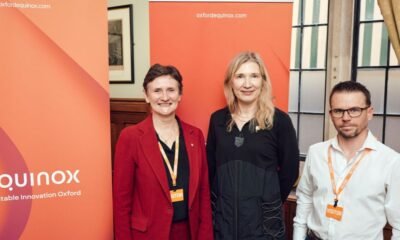
Oxfordshire’s Equinox 2035 strategy launched at House of Commons