
Student Life
‘Far-right’ Oxfordshire Patriots’ march opposed by larger Stand Up To Racism counter-protest


A protest organised by the far-right Oxfordshire Patriots group was outnumbered by an anti-racist counter-protest in Oxford today.
The Stand Up To Racism counter-protest, made up of around 50 people, met the Oxfordshire Patriots protests, made up of about 13 people, at Carfax Tower. From Cornmarket Street, they followed the Patriots down St Aldate’s Street, Speedwell Street, and round Westgate, ending at Bonn Square. At Bonn Square, the rival protesters faced off around the war memorial, chanting back and forth at each other.
Far-right group Oxfordshire Patriots assembled in Oxford as part of a ‘Stop the Boats: Enough is Enough’ protest. As they marched through Oxford, their chants included “where’s your passport, in the channel” and “you can never trust a lefty with your kids”. One held an AI-generated image of a bulldog biting into a dinghy.
Following the protesters around Westgate, Stand Up to Racism chanted: “fascist scum off our streets” and “when the Muslim community is under attack, what do we do? Stand and fight back”. Later on in the protest, they called out the Oxfordshire Patriots, explicitly saying: “Oxfordshire Patriots, we see you, racists and fascists through and through.”
A student at the counter-protest told Cherwell: “We are here in solidarity with all the different groups at risk of losing their rights. The far right stirs up division, but we have the resources and the privilege to protest against them.”

Speaking to Cherwell at the start of the counterprotest, Oxfordshire Stand Up To Racism organiser Ian McKendrick said that the Oxfordshire Patriots “want to parade to stop the boats flags around town today”. He argued that this was a “racist dog whistle” and that “they want to parade a racist message around town”. Regarding the goal of the counterprotest, he said: “We don’t want them doing that unchallenged. We want to show that Oxford is overwhelmingly anti-racist.”
As the counterprotesters followed the Patriots down St Aldate’s and Speedwell, their numbers visibly swelled. At times, they attempted to march in front of or mix with the Patriots’ group. Upon reaching Bonn Square, the Oxfordshire Patriots stood on the steps by the War memorial shouting “stop the boats” and “illegal immigrants aren’t welcome here”. They were surrounded by a much larger group of counterprotesters, joined by drummers from Extinction Rebellion.
McKendrick also accused the Oxfordshire Patriots of being aligned with far-right influencer Stephen Yaxley-Lennon (better known as Tommy Robinson) and Danny Tommo. Tommo, the leader of Patriot Platform, is best known for protests against small boat arrivals in Dover and Portsmouth earlier this year. Aiden Noble, the leader of Oxfordshire Patriots, would not speak to Cherwell to answer these claims. Noble did, however, lead a chant of “Oh Tommy Tommy” at Bonn Square and publicly called on Facebook for people to join the protests in Portsmouth this September.

At the end of the protest, McKendrick spoke to the Stand Up To Racism protesters on Cornmarket, saying, to big cheers, that the Oxfordshire Patriots had been “humiliated”. He added that “we can count that as a big win”.
Ending his speech, he alluded to the protests against Nathan Cofnas’ upcoming speaker event at Oriel College on Tuesday. He said that “we need thousands outside Oriel College to show we are going to be an unbreakable bulwark against that kind of fascism”.
Cherwell also spoke to some Oxford students involved in the counter-protest. They told Cherwell they had come down to counter the far right’s narrative that their views are popular, saying: “I came to invalidate their [the Far Right’s] arguments that they are the silent majority.”

The University of Oxford has produced a guide to strengthen the link between the academic institution and local schools.
This resource, Opening Oxford, focuses on what the University can give to local communities, and how the University itself can benefit from interacting with the wider region. In the foreword, Vice-Chancellor Irene Tracey described the University’s commitment to “strengthening the University’s links with our local communities” and “ensuring young people across Oxfordshire can see opportunities in the University, whether that is study, employment, or interest in our cultural assets”. She added that universities “thrive when they are part of the life of their region”.
Within the guide, curriculum-linked workshops, enrichment opportunities, and lectures are recommended to realise the University’s vision. The activities featured are available for primary school students through to those navigating higher education and career choices.
It also emphasises helping educators through teacher development opportunities and classroom resources. Specific programmes and resources, such as a two-week research programme at Oxford University Museum of Natural History for sixth-formers and St Anne’s Super-Curricular club which offers online classes, are recommended for those considering applying to universities, including Oxford. It highlights post-school opportunities at the University, such as work experience, careers, and apprenticeships.
This guide contributes to the University’s 2025-2030 Strategic Plan, which outlines how the University will partner with the local community to “sustain excellence in education and research, extend our impact through innovation, and exercise leadership…for the benefit of society”.
The project also builds on the academic outreach that the University has previously developed. Similar to The Oxford College Twinning Project, it attempts to develop a reciprocal relationship between town and gown in the city.
Pro-Vice Chancellor for External Engagement, Sport, and Community, Professor Alex Betts, acknowledges that available initiatives and outreach are “not always visible or transparent to teachers across Oxfordshire”. In his introduction to the guide, he hopes it will help close the educational attainment gap and ensure Oxford is not viewed by young people as “distant and unrelated to their lives”.
The programme’s aim overall is to make the University “relevant and inspiring to all”, not only to its students.

Oxford University’s BA Jurisprudence (Law) degree is under faculty review following concerns raised by external examiners and echoed by students, about teaching disparities between colleges.
In a 2026 report seen by Cherwell, both examiners outlined concerns about teaching disparities between Oxford colleges that could affect law students in Final Honour School (FHS) examinations. They questioned whether coordination between colleges was adequate and critiqued a “lack of process” in ensuring students are taught in a “roughly consistent way”.
“There seems to me to be a real possibility of unfairness depending on the topics chosen by the individual tutor in the College and the difficulty of individual questions on the paper,” the report said. One examiner suggested that these issues might not be resolved through simply broadening questions on the paper, while another questioned whether action was needed “to ensure a level playing field across the students in the University”.
Speaking to Cherwell, a final year law student described the situation as “problematic” for students. They said: “The faculty just don’t have enough control over what tutors put on their reading list.”
They told Cherwell that there is no set order for law tutors to teach topics. With the faculty reading list sometimes containing 10-12 weeks of content, this forces some students to teach themselves, especially if the topics not chosen by tutors are easier to score highly on in exams.
They also claimed that in rare instances, some tutors will not include mandatory cases on their reading lists. While these are available to find on the faculty reading list, “it’s on you to make sure you’ve been taught correctly”, according to the student.
Another student claimed that, in last year’s Administrative Law exam, finalists at their college were significantly disadvantaged because they were only taught the first eight weeks of content. They told Cherwell that at colleges where tutors were more versed in administrative law, students were taught more content which was less complex and more likely to come up in exams.
Another law student who graduated in 2025 told Cherwell that they found the tailoring of teaching to exams and the quality of essay feedback varied greatly between colleges.
A University spokesperson told Cherwell: “Undergraduate law teaching combines lectures and classes provided by the Faculty with tutorials arranged by individual colleges. While colleges are responsible for their own tutorial provision, we recognise the importance of ensuring that students are appropriately prepared for their examinations, regardless of their college.”
Cherwell understands that the Faculty of Law is currently reviewing the course and its teaching provision in a working group.

A collaboration between scientists at the University of Oxford and Wuhan University has made a major breakthrough in solar energy efficiency.
Researchers found that bismuth sulphide can absorb light strongly without losing the electrical charge it produces, making it a promising material for semiconductors, the part of a solar cell which converts sunlight into energy.
When a semiconductor absorbs sunlight, it uses its energy to free electrons and leaves tiny, positively charged ‘holes’ in their place. To produce electricity, these positive and negative charges must be rapidly harvested before they meet and cancel each other out. However, laws of physics state that a good absorber of light must also be a good emitter, and therefore the semiconductors that absorb light most strongly are also the ones that lose their charges most quickly.
Solar energy research has long been slowed by the difficulty of finding materials that balance semiconductor absorbency and efficiency.
The discovery of bismuth sulphide, published in Nature in October, unlocks a solution. The researchers discovered it has a rare quantum arrangement that allows it to absorb light efficiently while also making it harder for excited electrons and holes to recombine.
Solar energy constitutes only 6% of Britain’s electricity. Primarily because of Chinese investment, 91% of new global solar and wind facilities are cheaper than the cheapest available fossil-fuel power. However, weather, grid infrastructure, and technological limitations have created a firm ceiling on the UK’s solar energy harvesting. This comes as Prime Minister Andy Burnham has announced the launch of a new government body to invest in the national electricity grid, as concerns mount over the durability and capacity of the UK’s energy infrastructure.
The government projects that the solar sector will support 35,000 jobs by 2030. This includes roles within the solar technology company Oxford Photovoltaics, which contributed to the study. The company was founded in 2010 as a spin-out from the University and now claims to be “commercialising the world’s most efficient solar technology to power the next generation of clean energy”.
Solar energy is also expected to play a major role in the government’s plans for an Oxford-Cambridge ‘growth corridor’. A recent report suggests the UK’s premier innovation zone is falling behind its global rivals, as China continues to build as much as 74% of all solar and wind projects worldwide.
This discovery of the bismuth sulphide semiconductor may trigger changes in the renewable energy sector. To do so, however, requires rapid commercial implementation of the technology. Researchers have yet to establish whether the increased energy savings of bismuth sulphide are enough for it to turn a profit.



-

 Oxford united FC4 weeks ago
Oxford United beat Wigan Athletic 2-1 in League One victory
-

 Oxford united FC4 weeks ago
Ramsey on Oxford United’s Arsenal-inspired set-piece threat
-

 Oxford united FC4 weeks ago
Leicester City hit with same transfer embargo as Oxford United
-

 Traffic & Transport4 weeks ago
Andy Burnham launches campaign against ‘headphone dodgers’ on public transport | Transport policy
-

 Student Life3 weeks ago
“I am proud of being a Jew, and equally proud of being an Arab”: Professor Avi Shlaim on Iraq, Zionism and belonging
-

 Student Life4 weeks ago
I no longer want to be an astronaut
-

 Student Life3 weeks ago
The Vinted paradox: Consuming our way out of overconsumption
-
 Property & Housing4 weeks ago
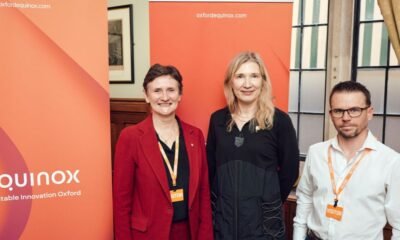
Oxfordshire’s Equinox 2035 strategy launched at House of Commons