
Student Life
Oriel Provost and Proctors confirm that Cofnas event will go ahead at Extraordinary SU meeting

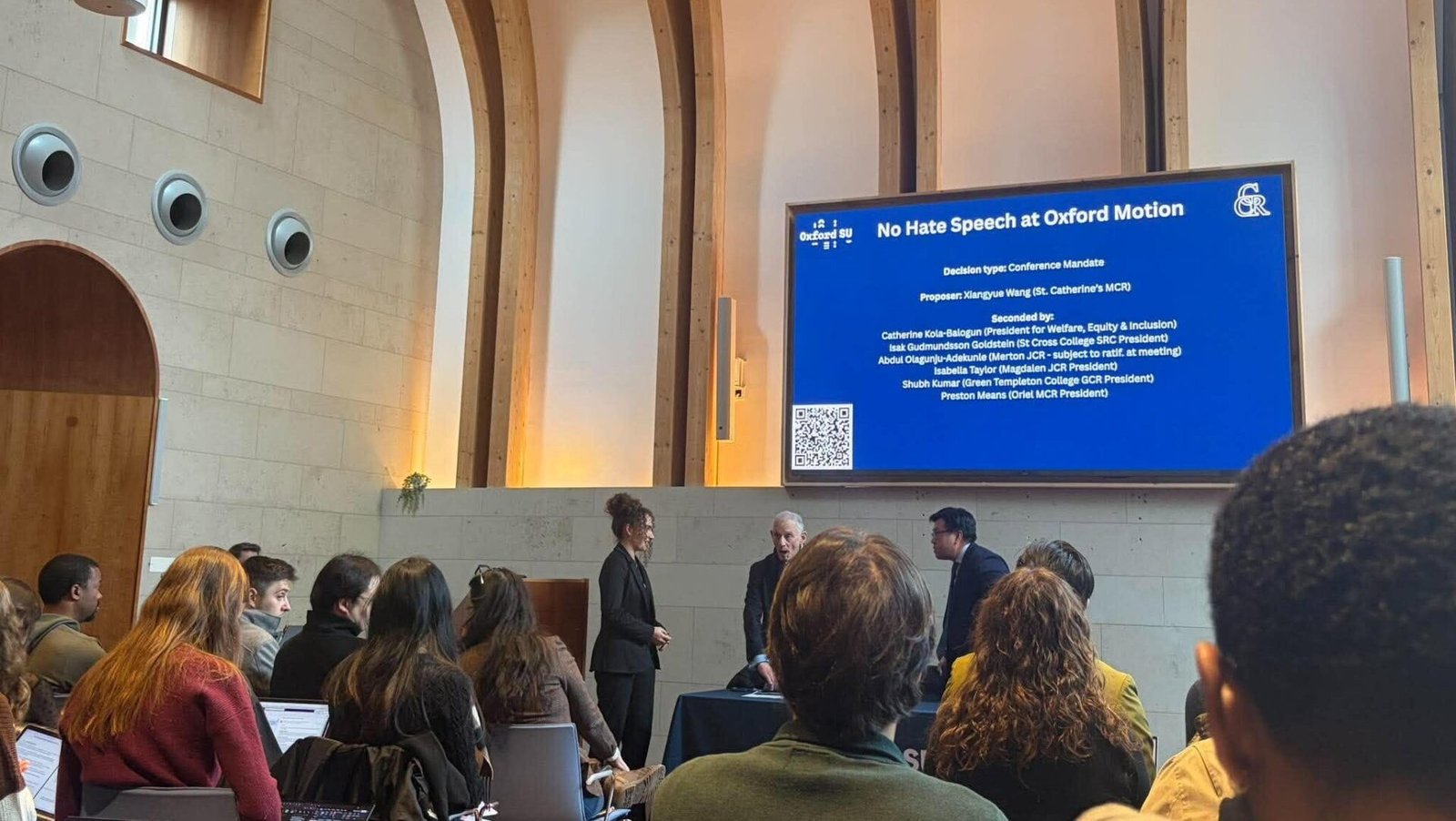
Lord Mendoza, Provost of Oriel College, confirmed that Nathan Cofnas’ event at Oriel will go ahead at today’s Extraordinary SU Conference of Common Rooms (CCR).
At the meeting, JCR and MCR representatives questioned Mendoza, alongside the Proctors’ Office Clerk Gillain Hamnett and the University of Oxford’s Chief Diversity Officer Tim Soutphommasane. Speaking on Oriel’s involvement in the event, Mendoza stated: “we want to live up to our statutory duty to protect free speech – free speech for the event and those to protest it.”
Mendoza also confirmed that the location of the event in Oriel has been changed to protect students.
Representatives from JCRs and MCRs as well as the SU representatives also debated a motion proposed by St Catherine’s College’s MCR president Xiangyue Wang, entitled: “No Hate Speech at Oxford”.
The proposed motion calls for a statement to be issued by the SU, pending voting from college representatives which is due to end tomorrow.
Further proposals include mandating the SU to spend £1,000 on diversity initiatives this term, for SU officers to ask the University’s proctors to attend the event in case of speech violating the 2010 Equality Act, and to support an independent review of the risk assessment and approval process for the event.
In the Q&A, students raised concerns that the content of Cofnas’s talk would not be lawful and could amount to harassment. The Ghent University academic is controversial for his role in publicising plagiarism allegations into Professor Jason Arday this July. Arday, who denied these allegations, resigned from Cambridge following media scrutiny and was later found dead.
The proposed motion notes that Nathan Cofnas is a self-described “race realist” who has previously said that without DEI (Diversity Equity and Inclusion), the number of black professors at Harvard would “approach 0%”.
One student asked whether the University considered race science and Eugenics an incitement to racial hatred. Soutphommasane responded by highlighting the University’s need to take students “in good faith” regarding the content of the events they plan to hold. Cofnas’s talk is publicised as a talk on whether DEI is “undermining higher education”.
Soutphommasane said: “I can tell you, as Chief Diversity Officer, these are questions I deal with every day. Having a debate with DEI is something that is not off limits for debate. I have to engage in these debates every day as a part of my job.”
A representative from St Antony’s College responded saying “it seems disingenuous to give [the speaker] the most generous benefit of the doubt given the broad range of things that could be said under the title [of the debate].”
Mendoza acknowledged the public outcry to cancel the event from students and staff across Oxford, saying “we don’t particularly want what, at best you might call a ‘controversial lecture’ But free speech guidance is clear. However enraged you might feel, however much you might feel something will damage the reputation of the institution.” He confirmed that the College has consulted lawyers who unanimously maintain that “the event must go ahead”.
The speakers continually highlighted the duties placed on the University by the Higher Education (Freedom of Speech) Act 2023. Following the implementation of the Act last year, both the University and Oriel have updated their Codes of Practice on freedom of speech to reflect the stronger legislative duty to protect lawful speech.
Under the Act, Universities and their constituent institutions, such as Oxford colleges, can be reported to a new Office for Students complaints scheme if they fail to protect the freedom of speech rights of visiting speakers and staff. The complaints scheme has the power to issue fines and mandate compensation to those affected.
Oriel’s new Code states that freedom of speech must be “robustly protected” and that cancellation of events is “undesirable and should be exceptional”. The code accepts that this means students will be “confronted with views that some find shocking, disturbing or offensive”. Mendoza also said that the code will likely be reviewed after the event, but that the policy is unlikely to change.
“This is a very serious moment for Oxford and its colleges,” Mendoza said. “This is not something we looked to take on, but we are fulfilling our duty. We are pleased to be an organisation that wants to protect freedom of speech.” He also noted Oriel’s strong support for DEI initiatives and its outreach work.
Hamnett confirmed that the Proctors are conducting an ongoing risk assessment to ensure the safety of students at the event. She said that society events are not approved in advance by Proctors and can only be cancelled by them pending a risk assessment assessing whether it is “safe and lawful”.
A representative from Nuffield College asked how the event could be approved if the assessment is still live. Hamnett said that the current situation is ongoing and “dynamic”, reassuring that there will be a cut-off period but “the decision, at the moment, is that nothing has come to light that would mean the event would be cancelled”.
St Catz MCR’s proposed No Hate Speech motion calls for the presence of the University’s Proctors or another independent supervisor at the event to monitor the event for speech potentially violating the 2010 Equality Act. Hamnett confirmed that the Proctor’s security officers, commonly referred to as “bulldogs”, would be at the event.
The CCR President, Roxana Rusu, explained that involving an independent body to supervise is “really crucial” and “something that we are really pushing for”.
Student representatives raised concerns about the Proctors’ role in the event, with one stating that “mitigations don’t make an event safe” and it is “disingenuous to say that this event is safe because the proctors are getting involved”.
Rusu explained that the Extraordinary CCR was called to ensure that measures decided at the meeting could be implemented as quickly as possible. “While we can only work with the structures we have previously,” she said “we really want to change them for the future, for the better”.
Oxford’s Reform society has previously defended the invitation on social media, noting: “since we are a student society registered with Oxford University, constituent colleges of the University are under a legal obligation to host events like ours by virtue of the Higher Education (Freedom of Speech) Act 2023”. The statement goes on to say “Reform society is committed to hosting Nathan Cofnas, and allowing attendees at the event to engage in respectful dialogue with the same.”
The Free Speech Union has encouraged members to send emails congratulating Mendoza and Oriel for “standing firm” and for its “excellent” code of practice on free speech.
Common Room Presidents will be voting on the motion in the next 24 hours. If the motion is passed, a statement is expected to be issued tomorrow.

The University of Oxford has produced a guide to strengthen the link between the academic institution and local schools.
This resource, Opening Oxford, focuses on what the University can give to local communities, and how the University itself can benefit from interacting with the wider region. In the foreword, Vice-Chancellor Irene Tracey described the University’s commitment to “strengthening the University’s links with our local communities” and “ensuring young people across Oxfordshire can see opportunities in the University, whether that is study, employment, or interest in our cultural assets”. She added that universities “thrive when they are part of the life of their region”.
Within the guide, curriculum-linked workshops, enrichment opportunities, and lectures are recommended to realise the University’s vision. The activities featured are available for primary school students through to those navigating higher education and career choices.
It also emphasises helping educators through teacher development opportunities and classroom resources. Specific programmes and resources, such as a two-week research programme at Oxford University Museum of Natural History for sixth-formers and St Anne’s Super-Curricular club which offers online classes, are recommended for those considering applying to universities, including Oxford. It highlights post-school opportunities at the University, such as work experience, careers, and apprenticeships.
This guide contributes to the University’s 2025-2030 Strategic Plan, which outlines how the University will partner with the local community to “sustain excellence in education and research, extend our impact through innovation, and exercise leadership…for the benefit of society”.
The project also builds on the academic outreach that the University has previously developed. Similar to The Oxford College Twinning Project, it attempts to develop a reciprocal relationship between town and gown in the city.
Pro-Vice Chancellor for External Engagement, Sport, and Community, Professor Alex Betts, acknowledges that available initiatives and outreach are “not always visible or transparent to teachers across Oxfordshire”. In his introduction to the guide, he hopes it will help close the educational attainment gap and ensure Oxford is not viewed by young people as “distant and unrelated to their lives”.
The programme’s aim overall is to make the University “relevant and inspiring to all”, not only to its students.
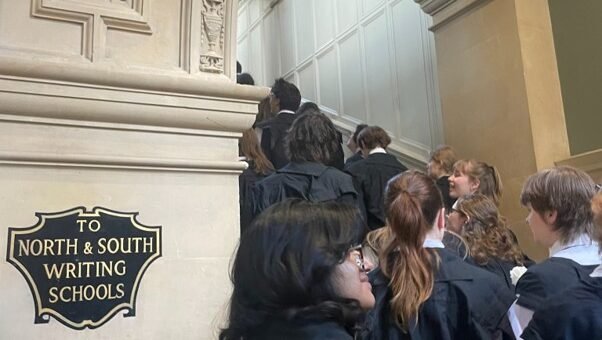
Oxford University’s BA Jurisprudence (Law) degree is under faculty review following concerns raised by external examiners and echoed by students, about teaching disparities between colleges.
In a 2026 report seen by Cherwell, both examiners outlined concerns about teaching disparities between Oxford colleges that could affect law students in Final Honour School (FHS) examinations. They questioned whether coordination between colleges was adequate and critiqued a “lack of process” in ensuring students are taught in a “roughly consistent way”.
“There seems to me to be a real possibility of unfairness depending on the topics chosen by the individual tutor in the College and the difficulty of individual questions on the paper,” the report said. One examiner suggested that these issues might not be resolved through simply broadening questions on the paper, while another questioned whether action was needed “to ensure a level playing field across the students in the University”.
Speaking to Cherwell, a final year law student described the situation as “problematic” for students. They said: “The faculty just don’t have enough control over what tutors put on their reading list.”
They told Cherwell that there is no set order for law tutors to teach topics. With the faculty reading list sometimes containing 10-12 weeks of content, this forces some students to teach themselves, especially if the topics not chosen by tutors are easier to score highly on in exams.
They also claimed that in rare instances, some tutors will not include mandatory cases on their reading lists. While these are available to find on the faculty reading list, “it’s on you to make sure you’ve been taught correctly”, according to the student.
Another student claimed that, in last year’s Administrative Law exam, finalists at their college were significantly disadvantaged because they were only taught the first eight weeks of content. They told Cherwell that at colleges where tutors were more versed in administrative law, students were taught more content which was less complex and more likely to come up in exams.
Another law student who graduated in 2025 told Cherwell that they found the tailoring of teaching to exams and the quality of essay feedback varied greatly between colleges.
A University spokesperson told Cherwell: “Undergraduate law teaching combines lectures and classes provided by the Faculty with tutorials arranged by individual colleges. While colleges are responsible for their own tutorial provision, we recognise the importance of ensuring that students are appropriately prepared for their examinations, regardless of their college.”
Cherwell understands that the Faculty of Law is currently reviewing the course and its teaching provision in a working group.

A collaboration between scientists at the University of Oxford and Wuhan University has made a major breakthrough in solar energy efficiency.
Researchers found that bismuth sulphide can absorb light strongly without losing the electrical charge it produces, making it a promising material for semiconductors, the part of a solar cell which converts sunlight into energy.
When a semiconductor absorbs sunlight, it uses its energy to free electrons and leaves tiny, positively charged ‘holes’ in their place. To produce electricity, these positive and negative charges must be rapidly harvested before they meet and cancel each other out. However, laws of physics state that a good absorber of light must also be a good emitter, and therefore the semiconductors that absorb light most strongly are also the ones that lose their charges most quickly.
Solar energy research has long been slowed by the difficulty of finding materials that balance semiconductor absorbency and efficiency.
The discovery of bismuth sulphide, published in Nature in October, unlocks a solution. The researchers discovered it has a rare quantum arrangement that allows it to absorb light efficiently while also making it harder for excited electrons and holes to recombine.
Solar energy constitutes only 6% of Britain’s electricity. Primarily because of Chinese investment, 91% of new global solar and wind facilities are cheaper than the cheapest available fossil-fuel power. However, weather, grid infrastructure, and technological limitations have created a firm ceiling on the UK’s solar energy harvesting. This comes as Prime Minister Andy Burnham has announced the launch of a new government body to invest in the national electricity grid, as concerns mount over the durability and capacity of the UK’s energy infrastructure.
The government projects that the solar sector will support 35,000 jobs by 2030. This includes roles within the solar technology company Oxford Photovoltaics, which contributed to the study. The company was founded in 2010 as a spin-out from the University and now claims to be “commercialising the world’s most efficient solar technology to power the next generation of clean energy”.
Solar energy is also expected to play a major role in the government’s plans for an Oxford-Cambridge ‘growth corridor’. A recent report suggests the UK’s premier innovation zone is falling behind its global rivals, as China continues to build as much as 74% of all solar and wind projects worldwide.
This discovery of the bismuth sulphide semiconductor may trigger changes in the renewable energy sector. To do so, however, requires rapid commercial implementation of the technology. Researchers have yet to establish whether the increased energy savings of bismuth sulphide are enough for it to turn a profit.



-

 Oxford united FC4 weeks ago
Oxford United beat Wigan Athletic 2-1 in League One victory
-

 Oxford united FC4 weeks ago
Ramsey on Oxford United’s Arsenal-inspired set-piece threat
-

 Oxford united FC4 weeks ago
Leicester City hit with same transfer embargo as Oxford United
-

 Traffic & Transport4 weeks ago
Andy Burnham launches campaign against ‘headphone dodgers’ on public transport | Transport policy
-

 Student Life3 weeks ago
“I am proud of being a Jew, and equally proud of being an Arab”: Professor Avi Shlaim on Iraq, Zionism and belonging
-

 Student Life4 weeks ago
I no longer want to be an astronaut
-

 Student Life3 weeks ago
The Vinted paradox: Consuming our way out of overconsumption
-
 Property & Housing4 weeks ago
Oxfordshire’s Equinox 2035 strategy launched at House of Commons