
Student Life
One f**king thing after another: ‘The History Boys’, revisited


Grab your motorcycle helmet. Sharpen up on the subjunctive. And cue the synthetic pulses of ‘Blue Monday’. The History Boys is back.
Alan Bennett’s 2004 play followed a cast of candidates vying for an Oxbridge place. Last month it was announced that the play is set to return to the London stage at the Theatre Royal Haymarket early next year. But we may ask: what’s the point of this revival?
I have to confess that I’m not quite a dispassionate observer of what a 2013 poll found to be Britain’s best-loved play. Bennett numbers among my favourite playwrights, and The History Boys among my favourite plays. When applying to Oxford, I didn’t consider Jesus or Corpus, as Irwin failed to get in there. I’m aware this is hugely embarrassing.
Despite my love for it, it’s hardly an uncontroversial work. AQA chose to remove the play from its GCSE syllabus in 2022. The frequent gripe for a contemporary audience is the play’s disturbingly frequent gropes. The idolised general studies teacher Mr Hector fondles his pupils on the back of a motorcycle. Whilst they’re all adults (just about), the pedophilic behaviour is deeply uncomfortable, especially so given Bennett’s initial wish for student Posner’s voice to be unbroken.
Though Bennett acknowledges this as a fault (“a grope is a grope. It is not the annunciation”, the terrific Mrs Lintott bites), he treats it as no more than a foible in an otherwise idealised picture. The final scene glorifies Hector with a funeral no less exalting than that of his mythic namesake. In another particularly delightful line, the “big man” can refer either to God or Hector. This issue aside, the play also undoubtedly has an air of entitled schoolboy arrogance, though I think Bennett is partly aware of it. Think Dakin’s cocky declaration: “We are so fucking clever.”
Perhaps more compelling than these reasons not to stage the play is the seeming absence of any reason to stage it. What’s it for? Just a cash grab? Would Forty Years On not be a better choice, his moving school-play-within-a-play that reappraises a postwar, post-Suez Britain? Why The History Boys? Why now?
A tenuous case could be made for its particular relevance today. In Burnham’s Britain, burdened by housing crises and championing vocational education, it’s apt that the most brilliant success of the play is Rudge’s business building homes for first-time buyers, whilst Posner (the only one who took all Hector’s teaching to heart) is unhappy at Cambridge, and persists in parasitic nostalgia for his schoolboy days. However, when speaking to The Times, even director Sir Nicholas Hytner couldn’t stomach a “specious” claim about its pertinence to today’s conversations about the education system.
The revival seems to be Hytner’s idea. Sir Nick is brilliant. Balancing Acts, his memoir on twelve years as artistic director of the National Theatre, is a tremendous read. His 2013 production of Othello is electric, and One Man, Two Guvnors is deftly delightful. His film direction of The Madness of King George (1994) is excellent if only for the climax: “I am the King!”, George declares, strapped into a chair. “No, sir, you are the patient!” returns the doctor as Zadok the Priest swells in this perverse anti-coronation. But can’t he do better? Following The Standard of Living earlier this year, is rehashing this old work the best Hytner can bring to the West End?
Perhaps Bennett suffers from a similar condition. His last effort was the film The Choral (2025), which, whilst moving, was a touch derivative. It became a tick-box list of Bennettisms: passions unfulfilled, power of art, Yorkshire. A scene towards the end echoes Bennett’s admittedly devastating Talking Heads episode, ‘Waiting for the Telegram’. There’s a whiff of Posner to this revival: a reliance on younger, more successful days. We have a 2020s remake of a 2000s play set in the 1980s based on Bennett’s 1950s schoolboy years.
But try as I might to scoff at it, I can’t help but be excited by the return. Crowther’s elegy for Hector may work well as a verdict on the play itself: “He was stained and shabby and did unforgivable things.” But “even his death was a lesson that added to the store”.
In all its blemished brilliance, The History Boys has lessons to add to the store. It speaks to us about the value of education, the struggles of growing up, and – perhaps most fascinatingly – the “sheer randomness of history”. Dakin’s discussions of how history happens, the unpredictability of Halifax’s teeth winning Britain the war, Rudge’s declaration that it’s just “one f***ing thing after another”, even the boys’ playing around “in the subjunctive mood”; these are all questions that play out in the narrative itself, with Hector’s potential expulsion, and the plot (and motorbike’s) lurch.
Whilst it’s easy to mock the play’s soppy view of literature, it’s both intensely moving and true. A poem can be that hand across history, reaching out and holding yours. The cast of characters is vividly sketched, from the plight of love-sick Posner serenading his unrequited sweetheart with Ella Fitzgerald, to the swaggering arrogance of Dakin, the razor-sharp satire of revisionist Irwin, and the no-nonsense and brilliantly perceptive Rudge.
It’s also great fun. Bennett captures the playful musicality of schoolboys teasing teachers: “Are jokes gonna be a feature, sir?” The film adaptation (a guilty pleasure) is similarly charming. It adds Penelope Wilton as an Art History teacher brushing the boys up in culture, and Adrian Scarborough as a devoutly religious press-up-demanding PE teacher (“give me 20!”, “what? Hail Mary’s?”).
These lessons might not be much, but, to butcher AE Housman’s words: all plays are worthwhile whether or not they serve the slightest human use. The History Boys numbers among them.
“Why now?”, we may ask. “Why not?”, we may answer. I’ll see you at the Royal Haymarket.

The University of Oxford has produced a guide to strengthen the link between the academic institution and local schools.
This resource, Opening Oxford, focuses on what the University can give to local communities, and how the University itself can benefit from interacting with the wider region. In the foreword, Vice-Chancellor Irene Tracey described the University’s commitment to “strengthening the University’s links with our local communities” and “ensuring young people across Oxfordshire can see opportunities in the University, whether that is study, employment, or interest in our cultural assets”. She added that universities “thrive when they are part of the life of their region”.
Within the guide, curriculum-linked workshops, enrichment opportunities, and lectures are recommended to realise the University’s vision. The activities featured are available for primary school students through to those navigating higher education and career choices.
It also emphasises helping educators through teacher development opportunities and classroom resources. Specific programmes and resources, such as a two-week research programme at Oxford University Museum of Natural History for sixth-formers and St Anne’s Super-Curricular club which offers online classes, are recommended for those considering applying to universities, including Oxford. It highlights post-school opportunities at the University, such as work experience, careers, and apprenticeships.
This guide contributes to the University’s 2025-2030 Strategic Plan, which outlines how the University will partner with the local community to “sustain excellence in education and research, extend our impact through innovation, and exercise leadership…for the benefit of society”.
The project also builds on the academic outreach that the University has previously developed. Similar to The Oxford College Twinning Project, it attempts to develop a reciprocal relationship between town and gown in the city.
Pro-Vice Chancellor for External Engagement, Sport, and Community, Professor Alex Betts, acknowledges that available initiatives and outreach are “not always visible or transparent to teachers across Oxfordshire”. In his introduction to the guide, he hopes it will help close the educational attainment gap and ensure Oxford is not viewed by young people as “distant and unrelated to their lives”.
The programme’s aim overall is to make the University “relevant and inspiring to all”, not only to its students.
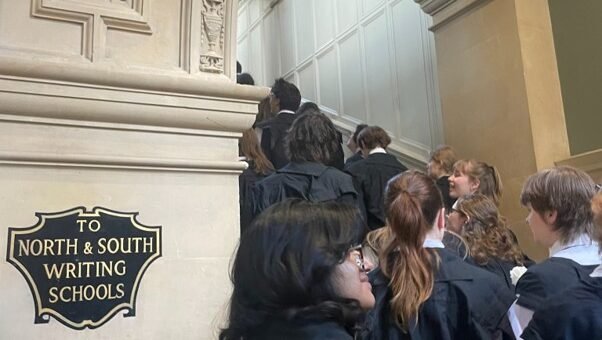
Oxford University’s BA Jurisprudence (Law) degree is under faculty review following concerns raised by external examiners and echoed by students, about teaching disparities between colleges.
In a 2026 report seen by Cherwell, both examiners outlined concerns about teaching disparities between Oxford colleges that could affect law students in Final Honour School (FHS) examinations. They questioned whether coordination between colleges was adequate and critiqued a “lack of process” in ensuring students are taught in a “roughly consistent way”.
“There seems to me to be a real possibility of unfairness depending on the topics chosen by the individual tutor in the College and the difficulty of individual questions on the paper,” the report said. One examiner suggested that these issues might not be resolved through simply broadening questions on the paper, while another questioned whether action was needed “to ensure a level playing field across the students in the University”.
Speaking to Cherwell, a final year law student described the situation as “problematic” for students. They said: “The faculty just don’t have enough control over what tutors put on their reading list.”
They told Cherwell that there is no set order for law tutors to teach topics. With the faculty reading list sometimes containing 10-12 weeks of content, this forces some students to teach themselves, especially if the topics not chosen by tutors are easier to score highly on in exams.
They also claimed that in rare instances, some tutors will not include mandatory cases on their reading lists. While these are available to find on the faculty reading list, “it’s on you to make sure you’ve been taught correctly”, according to the student.
Another student claimed that, in last year’s Administrative Law exam, finalists at their college were significantly disadvantaged because they were only taught the first eight weeks of content. They told Cherwell that at colleges where tutors were more versed in administrative law, students were taught more content which was less complex and more likely to come up in exams.
Another law student who graduated in 2025 told Cherwell that they found the tailoring of teaching to exams and the quality of essay feedback varied greatly between colleges.
A University spokesperson told Cherwell: “Undergraduate law teaching combines lectures and classes provided by the Faculty with tutorials arranged by individual colleges. While colleges are responsible for their own tutorial provision, we recognise the importance of ensuring that students are appropriately prepared for their examinations, regardless of their college.”
Cherwell understands that the Faculty of Law is currently reviewing the course and its teaching provision in a working group.

A collaboration between scientists at the University of Oxford and Wuhan University has made a major breakthrough in solar energy efficiency.
Researchers found that bismuth sulphide can absorb light strongly without losing the electrical charge it produces, making it a promising material for semiconductors, the part of a solar cell which converts sunlight into energy.
When a semiconductor absorbs sunlight, it uses its energy to free electrons and leaves tiny, positively charged ‘holes’ in their place. To produce electricity, these positive and negative charges must be rapidly harvested before they meet and cancel each other out. However, laws of physics state that a good absorber of light must also be a good emitter, and therefore the semiconductors that absorb light most strongly are also the ones that lose their charges most quickly.
Solar energy research has long been slowed by the difficulty of finding materials that balance semiconductor absorbency and efficiency.
The discovery of bismuth sulphide, published in Nature in October, unlocks a solution. The researchers discovered it has a rare quantum arrangement that allows it to absorb light efficiently while also making it harder for excited electrons and holes to recombine.
Solar energy constitutes only 6% of Britain’s electricity. Primarily because of Chinese investment, 91% of new global solar and wind facilities are cheaper than the cheapest available fossil-fuel power. However, weather, grid infrastructure, and technological limitations have created a firm ceiling on the UK’s solar energy harvesting. This comes as Prime Minister Andy Burnham has announced the launch of a new government body to invest in the national electricity grid, as concerns mount over the durability and capacity of the UK’s energy infrastructure.
The government projects that the solar sector will support 35,000 jobs by 2030. This includes roles within the solar technology company Oxford Photovoltaics, which contributed to the study. The company was founded in 2010 as a spin-out from the University and now claims to be “commercialising the world’s most efficient solar technology to power the next generation of clean energy”.
Solar energy is also expected to play a major role in the government’s plans for an Oxford-Cambridge ‘growth corridor’. A recent report suggests the UK’s premier innovation zone is falling behind its global rivals, as China continues to build as much as 74% of all solar and wind projects worldwide.
This discovery of the bismuth sulphide semiconductor may trigger changes in the renewable energy sector. To do so, however, requires rapid commercial implementation of the technology. Researchers have yet to establish whether the increased energy savings of bismuth sulphide are enough for it to turn a profit.


Dorchester Living and Homeless Oxfordshire celebrate first year of partnership

Oxford United hero Des Buckingham lands New Zealand job

Invest in international rail services to boost UK-EU reset, Burnham urged | Eurostar
-

 Oxford united FC4 weeks ago
Oxford United beat Wigan Athletic 2-1 in League One victory
-

 Oxford united FC4 weeks ago
Ramsey on Oxford United’s Arsenal-inspired set-piece threat
-

 Oxford united FC4 weeks ago
Leicester City hit with same transfer embargo as Oxford United
-

 Traffic & Transport4 weeks ago
Andy Burnham launches campaign against ‘headphone dodgers’ on public transport | Transport policy
-

 Student Life3 weeks ago
“I am proud of being a Jew, and equally proud of being an Arab”: Professor Avi Shlaim on Iraq, Zionism and belonging
-

 Student Life4 weeks ago
I no longer want to be an astronaut
-

 Student Life3 weeks ago
The Vinted paradox: Consuming our way out of overconsumption
-

 Property & Housing4 weeks ago
Oxfordshire’s Equinox 2035 strategy launched at House of Commons