
Oxford University
Supporting researchers to disclose AI use with confidence


“Our research into AI disclosure follows our 2024 survey, which revealed a wide range of initial perceptions towards AI. Two years on, AI use is more widespread, but there remain major differences in how researchers are adopting, applying, and disclosing these tools.
“At OUP, we’ve developed AI guidelines for authors with the view that the scholarship we publish must remain valued and protected. We regularly review these against industry guidelines and consider any feedback to ensure clear guidance for authors.
“We continue to prioritize working with the research community to develop clear publishing standards that support readers and authors in an AI-enabled world.”

We’ve launched our AI Study Assistant on Business, Politics, and Science Trove, following the successful launch of the tool on Law Trove in October 2025.
This means that all our Trove platforms now offer students enhanced functionality through AI to increase their efficiency when studying by helping them to find and engage with relevant content.
Troves—in business, law, politics, and science—offer discipline-specific collections of higher education textbooks from across our market-leading lists. Rolling out the AI Study Assistant more widely means that students from these disciplines can generate accurate summaries, authoritative answers, and targeted quizzes to support understanding, revision, and exam preparation. Moreover, responses and quizzes generated by the assistant only draw from our trusted textbook content, guaranteeing that students are accessing reliable source material.
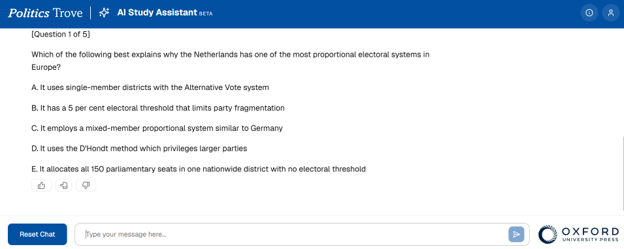
Building on the Law Trove AI Study Assistant
To expand the tool across our other Trove platforms, we further developed the assistant to meet user needs for Science Trove.
As with Law Trove, we have taken a conscientious approach to embedding AI into Business, Politics, and Science Trove by empowering users to develop the skills they need to apply critical thinking to their use of AI not just academically, but for their future careers through the specialized module on AI literacy. The module is available for all Trove users and covers generative AI fundamentals, academic integrity, critical thinking, and effective prompting, so users can use the AI Study Assistant responsibly and with confidence.
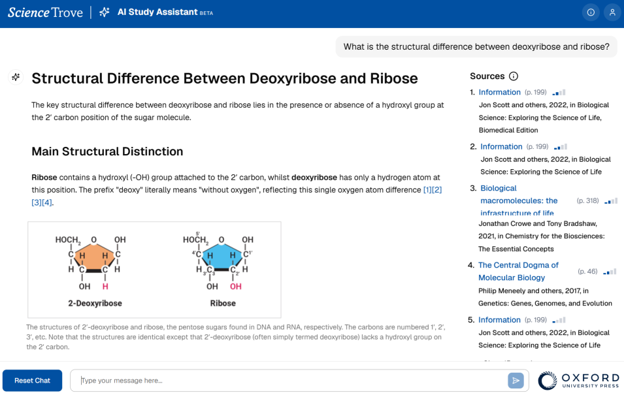
Shaped through user testing with lecturers and students, the tool has been designed with real teaching and learning needs at its heart, ensuring that Trove stands at the forefront of combining innovative technology with high-quality educative resources for higher education institutions and students.
We look forward to hearing how students interact with the tool across Trove in the new academic year and beyond. You can learn more about the development of the AI Study Assistant and the positive reception it has had on Law Trove here.

OUP Education and English Language Teaching teams were proud to participate in, and host, the attendees of the AIEOU (AI in Education at Oxford University) Summer School, in July.
The conference marked one year since the founding of this growing global community of researchers, academics, educators, industry leaders, and policymakers – united by the goal of tackling some of the biggest questions facing education today.
Dr Sara Ratner, of the University of Oxford’s Department of Education, designed a week-long programme in collaboration with colleagues at the University’s Social Sciences Division as well as a team at the UK’s Department for Education, bringing together diverse perspectives from over a hundred representatives of academia, schools, government, industry, and civil society.
Over the week, attendees discussed not only the advances in AI technology, but also what meaningful impact looks like in education.
Discussions throughout the week brought together diverse perspectives, asking difficult questions about what AI should do in education and demanding evidence of its impact on learner outcomes.
Sarah Ultsch, Director of Global Product at OUP, shared her impressions of the event: “The debates and workshops of this summer school have been tremendously important, because the decisions we make now will shape the experience of learners for years to come.”
She also highlighted her team’s recent launch of L2-Bench, the world’s first benchmark for evaluating AI in second language learning, culminating in the release of an open-source dataset for the benefit of the wider education and technology community.
During the week, summer school attendees were welcomed to OUP’s Oxford offices for an informal gathering and tour of the OUP Museum, which showcases key milestones and stories from our 500-year history. Liz Tyler, Managing Director of UK Education, welcomed participants and applauded the aims of the event that align with OUP Education’s commitments:

Liz Tyler
Managing Director, UK Education
“At OUP, we develop services to support teachers and schools that are based on evidence and research, and we are deeply committed to working with the sector and with experts to establish an evidence base that will help us understand how AI might improve teaching and learning.”
She also pointed towards recent research conducted by teams at OUP into student attitudes to the use of AI: the Teaching the AI Native Generation and Navigating AI in Education reports. These have shown how much students as well as their teachers need more data and evidence to guide the use of AI in developing cognitive skills and improving learning.
As the AIEOU community enters its second year, the conversations and partnerships sparked during the summer school will continue to shape the understanding of AI’s role in education. Through ongoing research and collaboration with the University of Oxford, OUP remains committed to helping the sector navigate the opportunities and challenges of AI and focus on improved learner outcomes.
Oxford University
Celebrating highlights in literacy, digital learning and assessment, and research publishing

Our Annual Report for 2025/26 is now available
The report shares a number of publishing highlights in research and education, as well as our continued commitment to our global communities and to operating sustainably.

Professor Irene Tracey
“I am so incredibly proud of what OUP contributes to Oxford and the world. The dedication of the leadership and staff, board members, and academic delegates is evident in their service to the Press.
“As we collectively balance the human need to create, tell, and share stories as the world around us changes at pace, I am confident that my colleagues at OUP will continue to uphold our long-held traditions while shaping the new.”

Nigel Portwood
“This has been a year of investment, innovation, and growth for OUP. Against a changing backdrop in some of our markets, we remained focused on fulfilling our mission by expanding our publishing portfolio, embracing new technologies, and developing tools and services to support learning and research across the world.”

Highlights from 2025/26
We acquired
Karger Publishers, a highly regarded medicine and health sciences publisher based in Switzerland.

1.3 million people
visited the Oxford English Hub, the home of our digital content for teaching and learning English.

We launched
Green Sparks, a strand of the Oxford Reading Tree which comprises 42 books that provide age-appropriate environmental education linked to the UN Sustainable Development Goals.

We met
our target of 100% certified sustainable paper for our print publications.

We donated
more than 154,000 books to readers worldwide.

The post Celebrating highlights in literacy, digital learning and assessment, and research publishing appeared first on Oxford University Press.


Supporting researchers to disclose AI use with confidence

‘Baggage reclaim was pandemonium’: passengers hit by airport IT chaos recount their ordeals | Airline industry

Empowering higher education students with AI
-

 Oxford News4 weeks ago
Train cancellation alert amid ‘fault’ near London Paddington
-

 Oxford News4 weeks ago
Museum evacuated and Oxford University closed amid incident
-

 Business & Technology4 weeks ago
Currys rolls out NiCE software to unify customer service
-

 Oxford News2 weeks ago
Richard Hammond takes control of classic car company
-

 Business & Technology3 weeks ago
Apprentices say AI is reshaping tech skills demand
-

 Business & Technology4 weeks ago
Love Island unknowns outshine influencers in growth
-

 Oxford Events4 weeks ago
Wilderness Festival 2026: four days of music, food, art and wild escapism
-

 Oxford News4 weeks ago
Royal Mail customer notice to anyone writing addresses by hand