
UK News
Chip stocks bounce back as OpenAI files for Wall Street float – business live | Business

Introduction: Chip stocks bounce back ahead of ‘brat summer’ for AI firms
Good morning and welcome to our rolling coverage of business, the financial markets and the world economy.
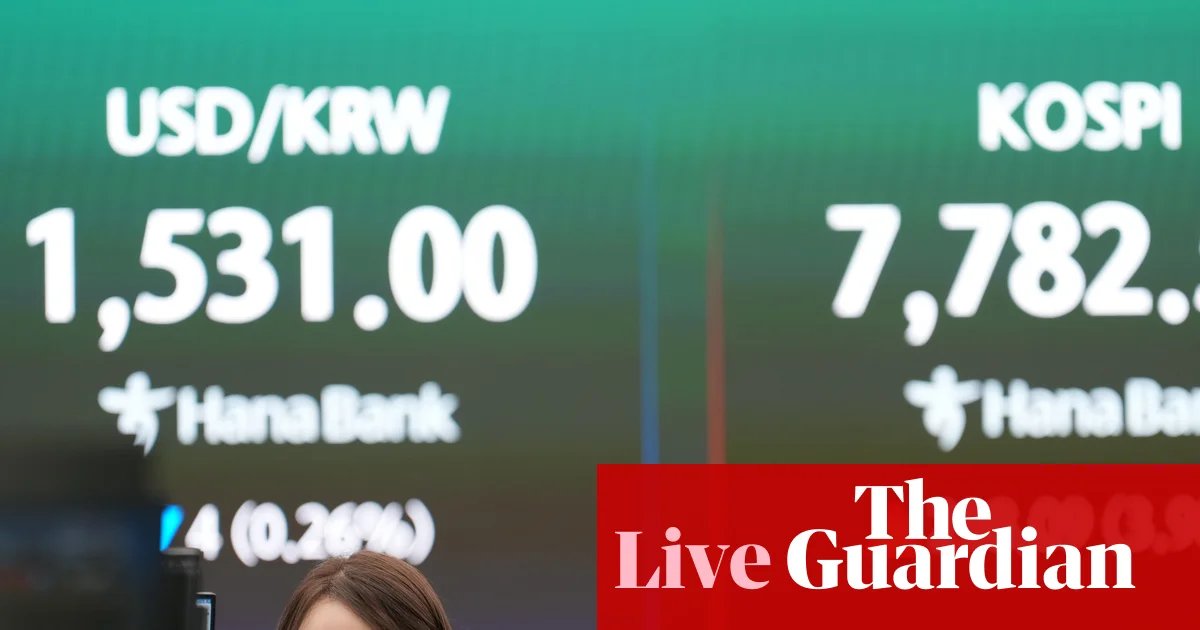
For the second day running, circuit breakers have been triggered on the Seoul stock exchange. But this time, it’s because the market is rising unusually quickly, rather than tumbling like it did on Monday.
Shares in South Korea’s chip giants are surging today, as investors pile back into the market after yesterday’s sell-off.
This rally is boosting optimism that the recent drop in tech shares is a blip, rather than the long-feared AI market crash.
Samsung Electronics’s shares are up over 9% today, while memory chipmaker SK Hynix have surged by 15%.
Those two heavyweight stocks have driven South Korea’s KOSPI up by 8.4% in Tuesday’s session, a day after it tumbled by 8%. Today’s market rally triggered successive temporary suspensions of program buy orders, known as “sidecars” in South Korea.
SK Hynix was boosted by a new multiyear partnership with Nvidia to develop next-generation memory for AI systems, whicch saw Nvidia’s Jensen Huang tour Seoul, meeting tech firms and handing out fried chicken to journalists:

Ipek Ozkardeskaya, senior analyst at Swissquote, points out that the wild swings in the KOSPI are unusual, and worrying.
A day with a rise or fall of less than 5% in the Kospi has become rare – a sign of just how volatile this market has become and, therefore, how much of the move is driven by speculation. Indeed, the Kospi’s volatility index keeps rising to unbelievable levels, suggesting that when the music stops, there will be carnage.
Anyway, today we continue to observe the tech-versus-non-tech narrative play out – technology attracting flows while non-tech pockets of the market lag behind.
That narrative will be tested in the coming months, though, as several massive tech firms attempt to float on the stock market.
Last night, OpenAI filed for its initial public offering – which could value the firm behind the ChatGPT chatbot at more than $1tn. That puts OpenAI in a race with fellow artificial intelligence pioneer Anthropic, and Elon Musk’s SpaceX which is due to float on Friday.
Kathleen Brooks, research director at XTB:
The OpenAI news means that we will hear more about how much revenue it is generating and how much cash it is burning through in the coming weeks.
2026 is set to be the ‘brat summer’* for these AI names, with their soaring valuations and big promises for how AI will change the world and send their revenues soaring.
[* For the benefit of any high court judges reading, here’s a guide to Charli xcx’s recent album, Brat]
The agenda
-
7am BST: German trade data
-
9:45am BST: Treasury Comittee hearing on Financial Inclusion Strategy
-
11am BST: NFIB’s US Business Optimism Index
-
1.30pm BST: US trade data for April
Key events
Chinese exports climb as AI boom drives trade
Strong demand for AI-related products led to a surge in China’s exports last month, new data shows.
China’s exports rose by 19.4% year-on-year in May, up from 14.1% in April, with chip exports more than doubling on an annual basis.
China’s exports of hi-tech products (50.9%), semiconductors (110.9%), automatic data processing machines (66.0%), mobile phones (44.3%), autos (39.3%), and ships (31.0%) continued to grow strongly in May, reported Lynn Song, ING’s chief economist for Greater China.
The pound is strengthening against the US dollar today, as calm returns to the markets.
Sterling is up a third of a cent at $1.3376.
Enrique Díaz-Alvarez, chief economist at global financial services firm and FX firm Ebury, says:
“A light week in terms of macroeconomic news out of the UK meant the focus for sterling traders was mostly elsewhere. We did see an MPC member (Greene) stating that she would consider voting for a hike at the next Bank of England meeting later this month.
“A notable upward revision in the PMI business indices last week suggests that the initial confidence drop was overstated and that the UK economy is more resilient to the Middle East events than first feared. We look to this week’s April monthly GDP data, released Friday, to validate this modestly optimistic view.”
OpenAI to float: What the experts say
Here’s some early reaction to OpenAI filing confidential paperwork for an initial public offering on the US stock market:
Chris Beauchamp, chief market analyst at investing and trading platform IG:
“Just when the supersized tech rally was looking a little tired, along comes the news of OpenAI’s decision to IPO.
Presumably the move has been spurred along by Anthropic’s recent move towards a public listing, but and now markets face the test of yet another superheavyweight firm listing to test demand for these highly-valued companies that promise to reshape not just the investing landscape, but the entirety of human society.”
Susannah Streeter, chief investment strategist at Wealth Club:
The race is on to extract money out of the roar of enthusiasm for companies providing the backbone to the artificial intelligence revolution. There’s now a hat trick of mega listings on the cards, with OpenAI’s filing for an IPO coming hot on the heels of Anthropic and SpaceX. The research company behind the hugely successful ChatGPT had first-mover advantage, buoyed by an early deal with Microsoft, but Anthropic has gained ground and is tackling adeptly from behind, winning reams of enterprise contracts.
The price of staying at the top of the game is eye-watering for OpenAI – it’s estimated to be spending more than $100 billion a year on the infrastructure and processing power to support its services and power the next generation of AI models. To stay high and dry in its AI fortress, the company reckons that by spending at this level, it will create a moat too difficult to cross for the competition, enabling it to keep raking in revenues and eventually turn big profits.
But this is a risk, especially with technological developments moving so fast, and future models not necessarily needing the capacity. The risk is that swathes of this infrastructure could become obsolete.
Kathleen Brooks, research director at XTB:
OpenAI is currently valued at $850bn, the ‘baby’ of the group, since Anthropic is now valued ahead of OpenAI at $965bn. The company laid out the ‘third phase of OpenAI’ on Monday and said that it is undertaking research into artificial general intelligence, and looking at becoming a ‘product company’.
The latter is interesting for investors, since it would be a major potential source of future revenue. Although it is early days, if OpenAI launches its own product range, it could become a major competitor to Apple and Google, and their share prices are worth watching closely on Tuesday.
Major Gulf stock markets have rebounded today, on relief that that Iran and Israel said yesterday they had stopped their latest spate of attacks.
Saudi Arabia’s benchmark index, the Tadawul, has gained 0.8%, with lender Saudi National Bank up over 3% earlier today.
Dubai’s main share index is up 0.75%, and Kuwait’s main market is 1.5% higher.
London’s stock market is slipping in early trading, down almost 0.5% or 48 points at 10,323.
Pharmaceuticals group GSK are the top faller, down 2.7%, after striking a $10.6bn (£7.9bn) deal to buy US cancer specialist Nuvalent.
Mining stocks are also lower, as are oil producers BP and Shell.
UK accounting watchdog to investigate PwC’s audit of WH Smith
The UK’s accounting regulator has launched an investigation into PricewaterhouseCoopers, over its auditing of travel retailer WH Smith.
The investigation will look into PwC’s auditing of WH Smith’s financial statements for the financial year ended 31 August 2024.
The Financial Reporting Council says:
The investigation will be conducted by the FRC’s Enforcement Division under the Audit Enforcement Procedure.
WH Smith is already being investigated by the City watchdog over an accounting error that misstated profits at its North American arm.
Surprise interest rate rise in Indonesia
We have a surprise interest rate rise, in Jakarta, triggered by the Iran war.
Indonesia’s central bank has raised interest rates by 25 basis points today, to 5.5%, as it tried to prop up the Indonesian rupiah.
The ‘off-cycle’ decision comes just a few weeks after the bank raised borrowing costs for the first time in two years,
The bank explained:
“This increase is a follow-up measure to strengthen the stabilization of the rupiah exchange rate against the impact of heightened global volatility caused by the war in the Middle East.”
Oil drops as Trump says Iran peace deal in ‘final throes’
The oil price is dropping this morning, after Donald Trump declared that negotiations towards an Iran peace deal are in their ‘final throes’.
The US president made the comments to reporters at JFK airport after attending the NBA Finals at Madison Square Garden (where he was roundly booed by the crowd)
Trump insisted that Iran and Israel “were going back and forth and now they both agreed through me to stop and we’re in the final throes of what will be a very, very good deal”.
Asked whether it would be matter of days or weeks, he said it would take “two or three days”, adding that the strait of Hormuz would “open up right away” once the deal was signed.
Brent crude has dropped by 1% this morning, to $93 a barrel – still around $20/barrel above its levels before the conflict began in late February.
The AI trade has continued to bounce back this morning, reports Deutsche Bank’s Jim Reid:
The KOSPI (+7.35%) is sharply higher after its 9th worst day in 45 plus years of history yesterday (-8.29%). The Nikkei (+2.19%) is also benefiting from a recovery in technology stocks after a decline of over -3.5% yesterday.
Chinese stocks are up just over half a percent and other markets are broadly flat. S&P 500 (+0.26%) and NASDAQ 100 (+0.54%) futures are also continuing to recover after a decent session yesterday.
Full story: OpenAI confidentially files for initial public offering
OpenAI has filed confidentially to go public on the US stock market, according to a company blogpost published on Monday. The artificial intelligence giant’s debut on Wall Street is expected to be one of the most highly valued listings in market history with a valuation at more than $850bn.
“We recently submitted a confidential S-1. We expect it to leak so we’re just announcing it,” the company’s post reads. “We have not decided on timing yet; it may be a while because there are things we want to do that are likely easier as a private company. But it’s a complicated set of tradeoffs and this gives us the option to go public sooner if that ends up being best.”
An S-1 is an investor prospectus submitted to the US Securities and Exchange Commission (SEC) in advance of an initial public offering (IPO). The confidential filing will give regulators a period to review and discuss the company’s financial disclosures before investors and the public are able to view them.
More here:
Introduction: Chip stocks bounce back ahead of ‘brat summer’ for AI firms
Good morning and welcome to our rolling coverage of business, the financial markets and the world economy.
For the second day running, circuit breakers have been triggered on the Seoul stock exchange. But this time, it’s because the market is rising unusually quickly, rather than tumbling like it did on Monday.
Shares in South Korea’s chip giants are surging today, as investors pile back into the market after yesterday’s sell-off.
This rally is boosting optimism that the recent drop in tech shares is a blip, rather than the long-feared AI market crash.
Samsung Electronics’s shares are up over 9% today, while memory chipmaker SK Hynix have surged by 15%.
Those two heavyweight stocks have driven South Korea’s KOSPI up by 8.4% in Tuesday’s session, a day after it tumbled by 8%. Today’s market rally triggered successive temporary suspensions of program buy orders, known as “sidecars” in South Korea.
SK Hynix was boosted by a new multiyear partnership with Nvidia to develop next-generation memory for AI systems, whicch saw Nvidia’s Jensen Huang tour Seoul, meeting tech firms and handing out fried chicken to journalists:
Ipek Ozkardeskaya, senior analyst at Swissquote, points out that the wild swings in the KOSPI are unusual, and worrying.
A day with a rise or fall of less than 5% in the Kospi has become rare – a sign of just how volatile this market has become and, therefore, how much of the move is driven by speculation. Indeed, the Kospi’s volatility index keeps rising to unbelievable levels, suggesting that when the music stops, there will be carnage.
Anyway, today we continue to observe the tech-versus-non-tech narrative play out – technology attracting flows while non-tech pockets of the market lag behind.
That narrative will be tested in the coming months, though, as several massive tech firms attempt to float on the stock market.
Last night, OpenAI filed for its initial public offering – which could value the firm behind the ChatGPT chatbot at more than $1tn. That puts OpenAI in a race with fellow artificial intelligence pioneer Anthropic, and Elon Musk’s SpaceX which is due to float on Friday.
Kathleen Brooks, research director at XTB:
The OpenAI news means that we will hear more about how much revenue it is generating and how much cash it is burning through in the coming weeks.
2026 is set to be the ‘brat summer’* for these AI names, with their soaring valuations and big promises for how AI will change the world and send their revenues soaring.
[* For the benefit of any high court judges reading, here’s a guide to Charli xcx’s recent album, Brat]
The agenda
-
7am BST: German trade data
-
9:45am BST: Treasury Comittee hearing on Financial Inclusion Strategy
-
11am BST: NFIB’s US Business Optimism Index
-
1.30pm BST: US trade data for April
The family of Shaun Burton, say they are “devastated” by the loss.
Source link
Key events
In the opening half an hour against Cape Verde, Mikel Oyarzabal, the centre-forward, did not get a single touch.
Kyle Green gets in touch: “Your highlighting of Lalas and his absurdity is something that has prevented me from wanting to watch the coverage on Fox. While every channel has its pros and cons I just can’t.
“I’m 45 and probably the youngest of anyone who remembers him as a player instead of an opinionated insert insult here. As for the match this could be more competitive than it looks on paper Spain need a win the pressure is on them. Saudi Arabia could hold out for a draw and see what happens in their last match. “
News from the England camp, and it seems to be good news on Declan Rice.
“I’m ready and fit, raring to go. I was feeling a little bit of neural pain in my hamstring, which I was managing from after Christmas with Arsenal for a very long time. Obviously, not a lot of people would have known that. It was all behind-the-scenes stuff but it was a smart decision.
“In the end, that last 20 minutes is probably where you pick up the most, and it’s where you play a 70-minute match. But that last 20 is where you really feel your body going for it. And I think it was a smart decision because the last few days I felt really, really good.”
Alex Reid has penned today’s weekend special Football Daily.
Portugal v Uzbekistan on Tuesday enticingly pits the incredibly nice, incredibly 41-year-old-superstar-tolerant Roberto Martínez against Fabio Cannavaro, who’s won a Ballon d’Or as a player and the Chinese Super League as a coach. While the fixture following that game really does see the dream of Thomas Tuchel – in his first international job with England – taking on Queiroz, who is in charge of his ninth national side with Ghana.
The expected formations are 4-2-3-1 for Spain, and 5-3-2 for the Saudi Arabians.
The Saudi team features two Donis changes: Ali Lajami, a defender, and Nasser Al Dawsari, a midfielder, are preferred to Mohammed Abu Al Shamat and Mohamed Kanno. You may recall Salem Al Dawsari, the Saudi captain, as the man who scored the winner against Argentina.
An entertaining read, even for those of us who have just seen the clips.
In a conversation where his co-panelist is casually reminiscing about his days playing alongside Messi or exchanging shirts with Ronaldo Nazário at the World Cup, what exactly is Lalas going to talk about – coming on as a second-half substitute for Earnie Stewart in a friendly against Scotland in 1998? Helping the Kansas City Wizards finish last in the 1999 MLS Western Conference? Did Lalas enjoy an elite playing career? No. But does he do the background reading that could compensate for his relative lack of standing in a conversation with titans like Henry and Zlatan? Also no. But is he charming or funny or charismatic or otherwise magnetic on screen? Eh, no.
For the record, I once interviewed Alexi Lalas on the challenge of playing against Romario in the 1994 World Cup. He had this to say:
“He could kill you in so many different ways. If you remember from that World Cup, he scored so many types of goals. That ranged from solo adventures to an outside-of-the-right-foot half-volley off a corner kick. Romario was both the most difficult to play against and the best that I have faced.
“Roberto Baggio was doing his thing, but in terms of consistency and living up to the hype, he [Romario] was the best. As with all stars, there was a moment when the fans sit up in their seats, and that was a feeling I got with Romario. When it got close to him and the potential for his involvement in a play was there, everybody sat up in their seat. They knew that something spectacular would be happening.”
Saturday’s match reports here.
The Saudi Arabia coach, and Blackburn legend, Georgios Donis, spoke about the challenges facing his team: “Spain is not the same team when Yamal or Williams are on the bench.
“While they still have plenty of possession, they lack the individual one-on-one penetration when these two are missing. I’m not saying it’s a problem for Spain, but when those players are missing, they play in a different way. We saw this very clearly against Cape Verde.
“We are playing against one of the best teams in the world, and it’s very important that when you play against these kinds of teams, you should enjoy the experience and respect the opponent, but not too much.
“It is very hard for any team playing against Spain to have any time in possession. So what we must do is to be more in control of our movement and compact, and when the ball goes through the lines, be able to defend dynamically.
“It’s nice to see miracles in football, and we’ve seen favourites losing against underdogs. Of course, it’s great for Saudi football to have a great memory of the result against Argentina, but we aren’t drawing anything from that.
“I think we’ll feel more pressure in that [Cape Verde] game than we will against Spain.”
The Spain coach, Luis De La Fuente had this to say in his Saturday press conference: “This generation of footballers is highly competitive and really fired up… It’s going to be a completely different story,” he said at his pre-match press conference on Saturday. There is no drama or crisis. The bottom line is simply that we need to win tomorrow.”
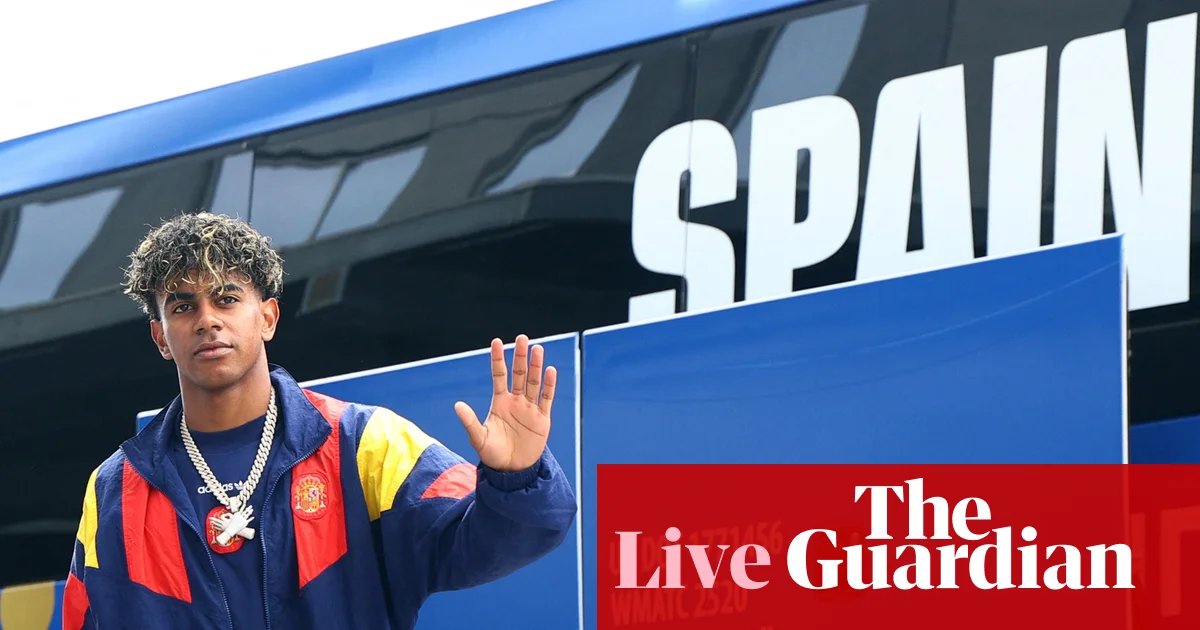
Four changes for Spain: Lamine Yamal, Pedro Porro, Dani Olmo and Alex Baena also come into the side with Marcos Llorente, Fabian Ruiz, Ferran Torres and Gavi dropping out.
The teams – Lamine Yamal starts
Spain: Simon, Porro, Cubarsi, Laporte, Cucurella, Gonzalez, Rodri, Yamal, Olmo, Baena, Oyarzabal. Subs: Raya, Joan Garcia, Pubill, Grimaldo, Eric Garcia, Llorente, Merino, Torres, Fabian, Gavi, Pino, Williams, Zubimendi, Munoz, Iglesias.
Saudi Arabia: Al Owais, Abdulhamid, Tambakti, Lajami, Al Amri, Al Harbi, Nasser Al Dawsari, Al Khaibari, Al Juwayr, Al Buraikan, Salem Al Dawsari. Subs: Al Aqidi, Al Kassar, Majrashi, Yahya, Al Shehri, Al Boushal, Kadesh, Al Johani, Al Ghannam, Al Hajji, Al Hamdan, Mandash, Kanno, Thakri, Abu Al Shamat.
Referee: Raphael Claus (Brazil)
Perhaps one of the Saudi -players can write themselves into this high-grade selection?
Perhaps it can be their goalkeeper.
Madrid screening of Spain v Saudi Arabia cancelled due to heat
The public screening of Spain’s World Cup match against Saudi Arabia in Madrid on Sunday has been cancelled because of extreme heat forecast for the Spanish capital, officials said.
The match, due to kick off at 6pm local time on Sunday, had been scheduled to be shown on a giant screen installed by the Spanish football federation (RFEF) at a fan zone in Plaza de Colón in central Madrid.
Madrid city council and the federation decided to cancel the screening after national weather agency AEMET issued an orange heat warning – the second-highest level – for the Madrid region, with temperatures forecast to reach 40C.
“The decision has been taken with the aim of protecting the health of attendees, event staff and support services involved in the event,” Madrid city hall said in a statement, apologising for any inconvenience.
Officials urged supporters to watch the match indoors in air-conditioned spaces and avoid prolonged exposure to the heat.
Large parts of Spain are experiencing unusually high temperatures for June as a mass of hot air from North Africa moves across the Iberian Peninsula.
A total of 13 of Spain’s 17 regions are on orange alert for heat on Sunday, while the northern Basque Country bordering France is on red alert, the highest level.
Authorities advised residents and visitors to take precautions during the heatwave, including drinking water regularly, staying in cool environments, limiting outdoor physical activity during the hottest hours of the day and taking extra care of vulnerable people. AFP
Can Saudi Arabia repeat the magic of 2022?
Argentina arrived in Qatar on a 36-game unbeaten run. When Lionel Messi opened the scoring from the penalty spot after 10 minutes, a comfortable afternoon seemed in the offing. Saleh al-Shehri and Salem al-Dawsari had other ideas, Argentina had three goals disallowed for offside in the space of 13 minutes and the greatest comeback in Saudi Arabia football history was made. Argentina went on to lift the trophy, while defeats to Poland and Mexico meant the Saudis did not reach the knock-out stage.
Unai Simon over David Raya is a controversial choice for De la Fuentes. The Arsenal keeper could lay claim to being Europe’s best this season.
“Those at the Champions League final had a few more days, so I got there on the Wednesday night,” Raya says. “I arrived a bit before Fabián [Ruiz]. I was saying hello to some of the others in reception when he arrived. I went to say congratulations; that was almost the first thing I did. I couldn’t really talk [to him] after the final; I just didn’t have it in me. The next day we talked about the game properly. Just two mates chatting … I was happy for him that he could lift the trophy for a second time.”
A high pressure game for the European champions, as Sid Lowe reports.
“If we had scored one, the game would have changed,” Martín Zubimendi said. Immediately after the game, De la Fuente had offered a simple analysis: when the ball doesn’t want to go in it doesn’t want to go in, he insisted. Spain had racked up 27 shots, after all. Ferran Torres had hit the bar and seen another clear opportunity saved. Vozinha, the 40-year-old goalkeeper who stopped that, saved six more and was named the man of the match. “There’s nothing to reproach the team for,” Rodri said. “We generated chances but couldn’t put it away; the good thing is they created almost nothing.”
We wait to see what role Lamine Yamal will play today. His coach would surely like to be able to use him.
The worst mistake we could make would be to compare him to anyone. He is the midst of a process. He has exceptional footballing maturity and lives it all with total naturalness. He has great serenity and strength. We have to let him follow his path but those players who have something different are ready for that. They’re geniuses, like Dalí [who] can paint a picture, or Michelangelo. They’re different. What is exceptional to us, isn’t to them. In those extremes, they feel comfortable. Why? Because they are different. What we think is exceptional, they consider normal.
Preamble
Spain’s campaign did not get off to a flying start, and Luis de la Fuentes may wake up in the night to visions of Cape Verde’s Vozinha. He will have Georgia on his mind ever since Monday. Saudi Arabia are no pushovers and gave Uruguay a scare in their opening match. Memories of downing Argentina four years ago still abound, and so Spain might beware. They can ill afford to go into the final game with Uruguay at a disadvantage. All eyes on Lamine Yamal, whose fitness situation remains opaque, though Spain need their other forwards to come to the party.
Kick-off 5pm UK, 1pm ET, 2am AEST. Join me.

A topless man can be seen driving erratically in Edinburgh before abandoning his car and attacking a black man and a delivery rider.
Source link



-

 Business & Technology3 weeks ago
HSBC UK & Visa test AI shopping with live payments
-

 Business & Technology3 weeks ago
Valarian lands USD $50 million backing for sovereign AI
-
 Oxford News4 weeks ago
DWP now checking bank accounts for Universal Credit and Pension Credit
-

 Oxford Events4 weeks ago
Henley Festival 2026 highlights: Five nights of unforgettable performances and festival moments
-

 Oxford united FC3 weeks ago
Oxford United three players who be kept after transfer ban
-
 Business & Technology4 weeks ago
Ode launches free AI voice service for poem recommendations
-

 Business & Technology4 weeks ago
ZYMIX uses Henley event to pitch social app to Gen Z
-

 Business & Technology2 weeks ago
Slice golf bar swings to new heights after successful launch