
UK News
Will the AI economy create a permanent underclass? | Kenneth Rogoff


The San Francisco Bay Area is in the midst of an AI frenzy that makes the California gold rush of the mid-19th century look like a scavenger hunt. Top programmers and developers are being offered compensation packages worth hundreds of millions of dollars to switch firms, while young engineers lucky enough to have joined leading AI startups early are contemplating retirement before age 35.
Driving up the Bayshore Freeway from San Francisco International airport into the city, you pass hyper-specific billboards advertising obscure AI applications seemingly aimed at absurdly niche audiences. How can that possibly be profitable? The answer is that in a city crawling with startups, getting the right software product in front of a founder whose company could soon be worth billions of dollars is far more lucrative than using billboard space to sell burgers or laundry detergent.
Yet beneath the frenzy lies a palpable anxiety, as members of this young super-elite fear that their startups may not be the ones to win the AI sweepstakes. Failure, in their eyes, means being left behind while AI automates large swaths of white-collar work – especially coding jobs, which until now have been a veritable licence to print money – and falling into the ranks of the permanent poor.
Though economists still debate whether AI will destroy jobs or create them, the prevailing mood in Silicon Valley is far more pessimistic. Either your startup makes it within the next five to ten years, the conventional wisdom holds, or you’d better pray the government provides a generous universal basic income.
Despite President Donald Trump’s efforts to pull Silicon Valley into the Maga orbit, American-style progressivism continues to dominate Bay Area culture. Most of California’s young tech strivers still see themselves as dyed-in-the-wool progressives –enthusiastic supporters of taxing the rich, at least until they become rich themselves.
Yet for all their virtue signaling, Silicon Valley elites seem strangely oblivious to the fact that the vast majority of people left behind by the rise of AI will not live in the US. Nor will they live in countries that have secured a place in the AI supply chain, such as South Korea, Japan, and Taiwan.
While South Korean firms such as Samsung and semiconductor company SK Hynix have become trillion-dollar giants on the back of AI’s insatiable demand for advanced memory chips, Europe has produced far fewer success stories. ASML, the Dutch firm that holds a near-monopoly on the high-end lithography machines needed to manufacture the world’s most advanced semiconductors, is a rare exception. The picture is even bleaker in Africa and Latin America, which have yet to produce anything remotely comparable.
Countries that fail to carve out a place for themselves in the emerging AI economy risk ending up on the losing side of this century’s most consequential economic transformation. With no windfall profits to redistribute and no surge in tax revenues to finance universal basic income, they could find themselves with no way to cushion the shock of mass job displacement.
This is not simply a story of political incompetence or lack of ambition. How can African firms compete when hundreds of millions of people across the continent still lack access to electricity, the most basic prerequisite for AI infrastructure? And how can Latin American countries finance massive investments in datacentres when savings rates remain low and a history of recurring debt crises continues to deter foreign capital?
To be sure, some African and Latin American countries stand to benefit enormously from AI’s voracious appetite for minerals such as copper, rare earths, lithium, nickel, cobalt, gallium, and germanium. Chile, Peru, and Mexico are obvious candidates, but even the cobalt-rich Democratic Republic of the Congo could reap substantial rewards if its brutal civil war ever subsides.
Natural-resource wealth, however, has often proven to be as much a curse as a blessing. Mineral-rich countries may find themselves flush with AI-driven revenues and still lack the political and economic institutions needed to spread the gains across society.
India, meanwhile, faces a very different set of risks. With AI devouring mid-level white-collar workers like plankton, India’s vast outsourcing industry could be among the hardest hit. Given its deep reserves of creative and technical talent, India could still emerge as one of the big winners of the current tech race, alongside the US and China. But the country has struggled to harness that potential at home, allowing many of its brightest minds to migrate to California. Trump’s immigration crackdown may slow that brain drain, though whether that ultimately benefits India remains an open question.
China, for its part, is already an AI powerhouse. But even there, the government is only beginning to grapple with the implications of AI-driven job displacement. Even if the country wins the AI race, maintaining social stability could prove difficult without expanding the social safety net.
The US may be more dynamic, but it is hardly better prepared for AI’s likely impact on labour markets. To avoid deepening social fractures, it will need to find ways to distribute the benefits of AI more broadly rather than allowing them to remain concentrated in the hands of a small group of first movers and tech billionaires.
But the danger is not confined to national borders. AI threatens to widen the gulf between technological winners and losers, enabling wealthy countries to reap the rewards while consigning billions of people across the developing world to fall ever further behind. No one really knows what such a world would look like, let alone how to keep it from tearing itself apart.
Kenneth Rogoff is a professor of economics and public policy at Harvard University. He was the IMF’s chief economist from 2001 to 2003.
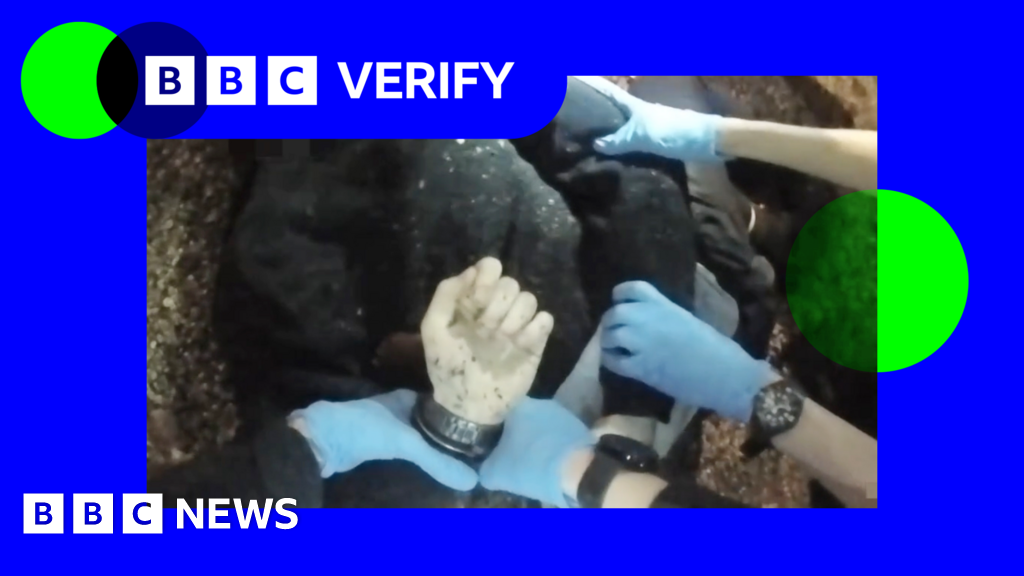
An 18-year-old Southampton student, Henry Nowak, was handcuffed after being stabbed by Vickrum Digwa, 23, who lied to police at the scene, claiming he had been the victim of a racist attack.
Digwa has been jailed for life with a minimum 21-year term.
Nowak’s parents said they hold Digwa solely responsible for the murder of their son, but the way he was treated by police was inhumane and degrading. Hampshire police has apologised to Henry’s family and the case has now been referred to the Independent Office for Police Conduct.
BBC Verify has analysed bodycam footage that was released by the police, with the permission of Nowak’s family, and looked at the key moments before Henry Nowak’s death. Merlyn Thomas reports.
Additional reporting by Emma Pengelly. Produced by Tom Joyner. Graphics by Sally Nicholls.
UK News
England v India: third and deciding women’s T20 cricket international – live | Women’s cricket
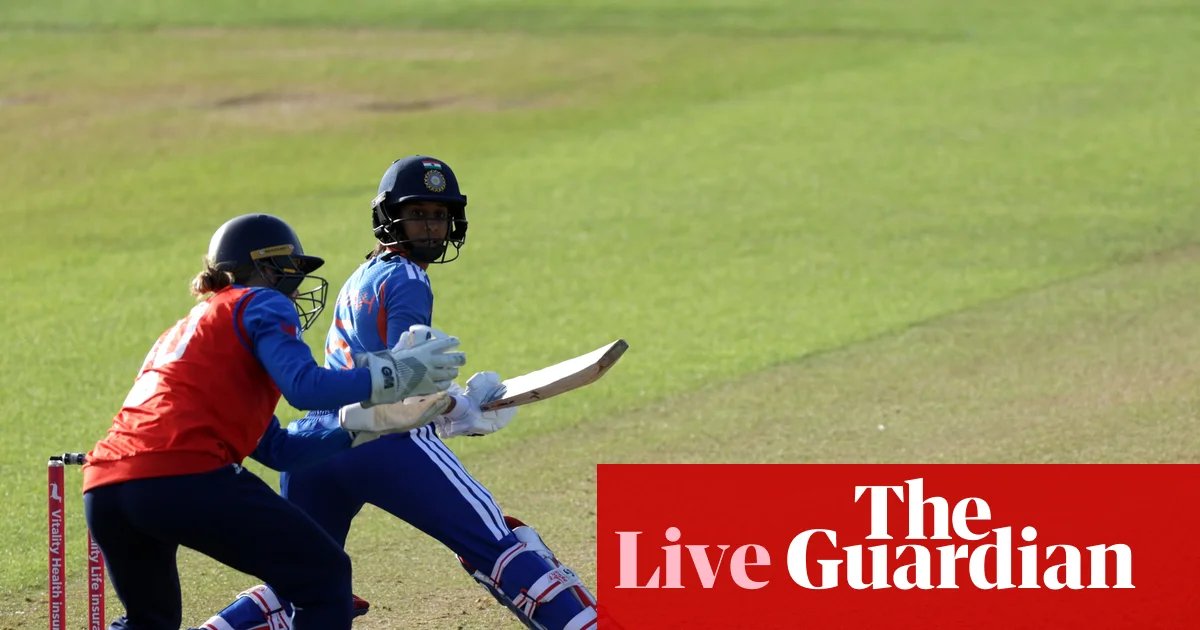
Key events
16th over: India 140-4 (Harmanpreet 40, Sharma 14) Chase that! Harmanpreet takes a balletic step and flames Dean through the offside for four. But Deepti Sharma hasn’t got in the zone yet and is unable to reach the boundary with the same regularity.
15th over: India 132-4 (Harmanpreet 32, Sharma 12 The wind is really billowing the flags now. Deepti goes down the ground, but doesn’t get enough omphph on Smith to reach the rope. But Harmanpreet does – a mightly slap four four.
14th over: India 122-4 (Harmanpreet 29, Sharma 8) Gibson starts with a wide, but follows up with a couple of dots. She’s an energetic fielder off her own bowling, bounding left and right. India remain boundary-less untill Harmanpreet pulls Gibson’s last ball with some welly past the chasing fielder.
Stephen Nicols gets in touch to reply to Kevin Wilson (over five).
“I’m hoping there are a few more runs left in our batting line-up before we pension them all off. A chase of 200-ish tonight will be hard work, and more good prep for the batters before the World Cup. And I reckon we’ll need all the batting experience we can get for the Test Match at Lord’s.”
13th over: India 113-4 (Harmanpreet 22, Sharma 7) India are in danger of running into a boundary-less patch – as they did at Bristol. The sun is out now, but India can only milk five from Ecclestone.
12th over: India 108-4 (Harmanpreet 18, Sharma 5) Seven from Dean’s over, including a wide and a run-out chance – if Gibson had hit, Deepti could have been in trouble, diving and travelling like a truck through treacle. She is patched up.
11th over: India 101-4 (Harmanpreet 17, Sharma 1) Bell with the rebuild over and rebuild she does. Rodrigues had just pulled her for four before losing her timbers. Deepti Sharma leapfrogs the order to come in next.
WICKET! Rodrigues b Bell 29 (India 100-4)
Flummoxed by the slower ball, an advancing Rodrigues can only turn around to confirm her miserable fate. A delighted Bell punches the air.
10th over: India 94-3 (Rodrigues 24, Harmanpreet 16) Harmanpreet chomps into a short ball from Smith, thrashing it square past two diving England fielders, then dispatches the last offering before drinks for another four through point.
9th over: India 82-3 (Rodrigues 23, Harmanpreet 5) England can’t keep Rodrigues still in the crease, and her ceaseless movements gives her options. She ramps Gibson for four, then swots a short ball past a diving Smith for another.
Harmanpreet today overtakes Susie Bates as the most capped player in women’s cricket – with 368 games for India under her belt.
8th over: India 71-3 (Rodrigues 14, Harmanpreet 3) Harmanpreet and Rodrigues make for a stylish duo at the crease. A fistful of singles from Eclestone’s second over, then Rodrigues shimmies a wider final ball with dancing wrists to the backward point boundary.
7th over: India 63-3 (Rodrigues 8, Harmanpreet 1) Dani Gibson stops the flow of boundaries, and the run out of Bhatia could be crucial.
WICKET! Bhatia run out (Ecclestone) 32 (India 60-3)
Ecclestone with her left hand, a fishtail plait running down her back, runs out the lumbering Bhatia with a throw to the non-striker’s end . A vital wicket for England, Bhatia was in the zone
6th over: India 57-2 (Bhatia 32, Rodrigues 3) Bhatia signs off from the power play with three more boundaries, this time off Dean. An off-balanced sweep, a here-we-go up and over, and finally hammering her down the ground like a rogue nail
5th over: India 45-2 (Bhatia 20, Rodrigues 3) Bhatia, dealing mostly in boundaries this evening, slog-sweeps Ecclestone to pick up four. Four singles on top keeps the scoring rate perky.
Hello Kevin Wilson! “England probably decided a while back not to roll the dice before a home World Cup but they should probably move on from DWH, Knight, NSB and Jones after this tournament. The side has suffered from moving too many batters around in the past. Time to bring new players in, in fixed positions. I’m not sure I see a role for Gibson. England have plenty of batters who can bowl. Wong has been out of sorts for a while. Invest in Gaur instead.”
4th over: India 37-2 (Bhatia 9, Rodrigues 1) Dean makes the breakthrough in her first over – India are scoring quickly, but losing wickets.
WICKET! Mandhana lbw Dean 8 (India 36-2)
The dog changes the channel by leaping off the sofa with one paw on the controller, when I put it back on, India have appealed an lbw decision. Madhana had gone to sweep, it looks pretty out – even Mandhana looks like she thinks it is out – and out it is.
3rd over: India 31-1 (Mandhana 8, Bhatia 9) Two wides and two fours from Bell’s second over as she gets some punishment from Bhatia, through point and deep third.
WICKET! Verma c Dean b Smith 11 (India 19-1)
Verma is eager for more runs but cramped for room, gets an outside edge ball which holds up in the wind and Charlie Dean collects at point. Clever bowling
2nd over: India 19-1 (Mandhana 7, Bhatia 0) Linsey Smith in sunglasses from the other end. Mandhana clips her off her toes, over the leaping Bell at midwicket for four. Then Verma joins in hawking her through backward square for four more. But then the wicket!
1st over: India 10-0 (Mandhana 2, Verma 7) Lauren Bell directs the field at the top of her mark. The wind ruffles her shirt, the sun suddenly out and glinting on her bun as the church of St James looks on. Mandhana hoiks Bell up and just over mid on, but Verma earns the style points, delicately angling the ball down to the rope. A handful of singles and a wide.
“There’s a good crowd building,” says Raf. “I’m told they’re expecting at least 5,000 people which will be near capacity.”
Selection talk
Sky’s crew talk England selection for the World Cup – they put Capsey/Dunkley/Knight//Gibson/Wong/Corteen-Coleman and Filer up for discussion.
Charlie Dagnall. “I think Capsey accesses more areas of the field, can manipulate the surface a bit more, better against pace and spin, Dunkley is a little bit more one dimensional. Kate Cross agrees, “Capsey can hit areas of the ground where it needs to go, Dunkley doesn’t have that many more options than hitting over the top.”
Tash Farrant “Dunkley and Wyatt Hodge run really well together,I’d back her, tell her she needs to get off to a fast start. She does look quite tentative at the moment though.” She would pick Capsey and Dunkley and leave Knight out, also Capsey and Dunkley are better in the field and running quick singles.
Cross goes for Knight because you need experienced players, despite her lack of strike rate. “There is no space for anchors any more in the women’s game.”
Dagnall says he’d go for Knight as she’s a better player with NSB in the side.
Farrant says Edwards needs to be more flexible with the batting order.
Dunkley goes for Wong “a difference maker, a big game player.”
Farrant would pick Dani Gibson as England need to stack the batting. As would Cross who says Gibson is more of the future of England cricket than Wong.
And here comes Sue Redfern and the teams.
I’ve just disturbed Raf mid-forkful of white chocolate cheesecake in the Taunton media centre.
“We’ve watched two brilliant warm-up acts – we had drummers earlier and now we’ve got a group of dancers with Indian flags. Overcast and windy at the moment, but it’s been dry all afternoon.”
India XI
India make one change, seamer Kranti Gaud comes in for spinner Shreyanka Patil.
India: Smriti Mandhana, Shafali Verma, Yastika Bhatia, Harmanpreet Kaur (c), Jemimah Rodrigues (wk), Richa Ghosh, Deepti Sharma, Arundhati Reddy, Kranti Gaud, Sree Charani, Nandni Sharma.
England XI
No changes from Bristol.
England: Sophia Dunkley, Danni Wyatt-Hodge, Amy Jones (wk), Alice Capsey, Heather Knight, Freya Kemp, Danielle Gibson, Charlie Dean (c), Sophie Ecclestone, Linsey Smith, Lauren Bell.
England win the toss and bowl!
It’s blowy out there. Charlie Dean looks pleased. “The win at Bristol was brilliant for us, a confidence builder, hopefully we can do more of the same today.” England play the same team.
Preamble
Roll up, roll up for the final game in this T20 World Cup warm-up series. Happily for the crowd, it’s a decider with meaning, England and India both have a point in the purse – and the winner will take the momentum with them into the tournament proper. They’ll toss the coin at 6pm BST, with play starting half an hour later. Pull up a chair and join us!

The 18-year-old’s murder has sparked debate among politicians over attitudes in policing.
Source link



-

 Crime & Safety3 weeks ago
Waitrose supermarkets across UK shut due to ‘critical error’
-

 Crime & Safety3 weeks ago
Man arrested in connection with rape in Oxfordshire town
-

 Crime & Safety3 weeks ago
Banbury woman jailed after lying to police about kidnapped children
-

 Crime & Safety3 weeks ago
How to spend a day in Harpsden among UK’s poshest villages
-

 Oxford Events3 weeks ago
Stage Watch: Somerset House enters the comedy arena with major new festival Laughterama
-

 Crime & Safety3 weeks ago
Strictly Come Dancing new hosts reportedly Emma Willis
-

 Business & Technology4 weeks ago
CBI posts 14% revenue rise as payment services grow
-

 Crime & Safety3 weeks ago
UK Hantavirus update as 22 ship passengers moved to hospital