
UK News
‘Should we leave them to die?’ The battle over how to save orangutans from the curse of palm oil | Wildlife

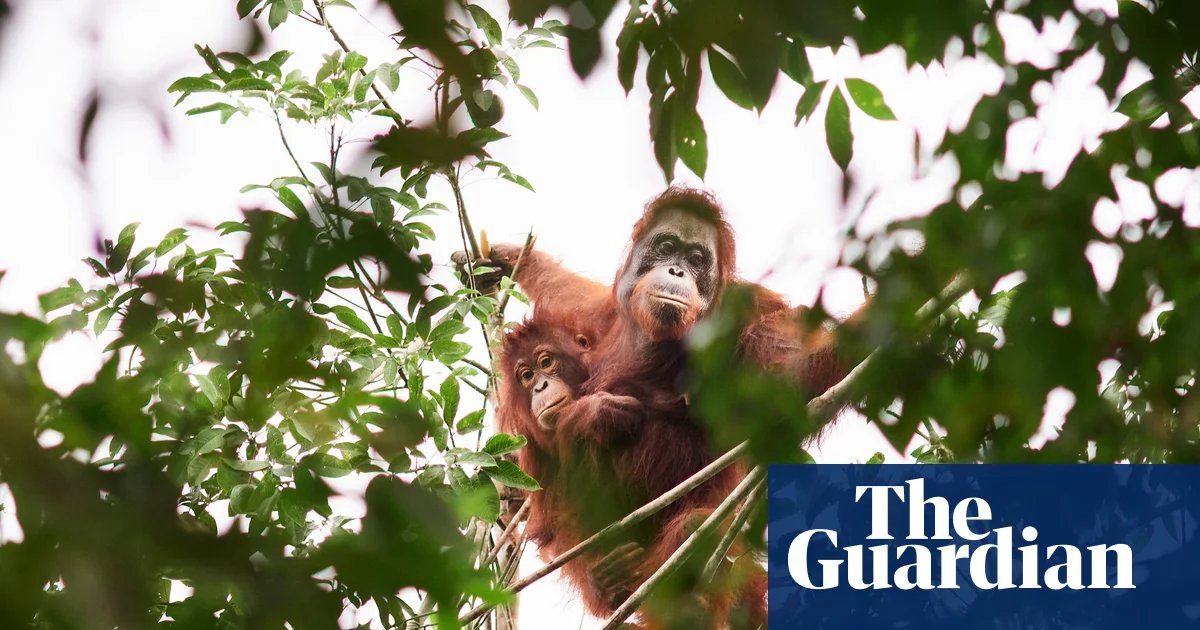
The banana skins were an ominous sign. As was the branch that had been broken off to get to the fruit. Had Edi Ramli walked into the forest, he might have seen scattered balls of bark that had been ripped off trees, chewed like gum, then spat out. It takes a powerful jaw to do that. Closer to Edi’s home, there was an intricate construction of bent and broken branches high in a tree. The nest.
It was October, the fruiting season. The pile of half-eaten bananas was less than a minute’s walk from where Edi and his family slept. He felt nervous. He got on with his day. He picked sweetcorn and sold it at the market. He bought a carton of chocolate milk and biscuits for his grandson. He and his wife, Siti Munawaroh, ran the farm with their three adult children. They prepped the land, sowed seeds, tended crops. Survival depended on what they could grow.
Now, at five in the afternoon, the light was beginning to fade. Suddenly, Edi heard a cry. A neighbour’s child who’d been bathing in the river came running back, frightened. He said he’d seen an orangutan. Edi ran towards the river, the farm’s guard dog at his heels. In a clearing barely 100 metres away, he saw the reddish bulk of the orangutan. It was an adult male; he could tell from the large cheek pads. The creature was huge, about 90kg, and a good deal stronger than he was. One swipe and he’d be knocked to the ground. The dog ran after the orangutan, barking ferociously. The orangutan disappeared into the undergrowth.
Edi, 55, and Siti, 51, live on a small farm on the southern, Indonesian part of the island of Borneo, called Kalimantan, in a remote spot on the west coast. They are originally from Java, the island that is home to more than 157 million people. A decade ago, Edi was working as a builder and Siti as a machinist in a garment factory. But they found Java stultifying, and disliked the crowds, the noise and the pollution. Then they discovered the government would pay to move them elsewhere.
In 2016, Edi and his family joined a scheme set up to relocate people from Indonesia’s overcrowded inner islands to the less populated outer islands. The scheme, known as transmigration, was a form of experimental population engineering on a grand scale. It was started in the 19th century by Dutch colonialists, and reached its peak in the 1980s: 2.5 million people were resettled between 1979 and 1984. Each family is given land, a house and a small amount of money (about 4m rupiah: £170).
Edi and his family loved their new home, a haven of light and space after the city. But unbeknown to him, he’d been encouraged to settle near one of the largest populations of wild orangutans in West Kalimantan. About 2,500 live in Gunung Palung, the national park almost on his doorstep. His farm is close to the park’s buffer zone, a strip of land supposed to cushion the protected forest from human development. But it’s not demarcated. There are no deep ditches or high walls. And, of course, orangutans don’t know boundaries. Besides, the land Edi was now cultivating had once been their territory. Orangutans can live for up to 45 years and have strong territorial instincts. They carry on visiting the areas they’ve always ranged in, even when those areas have been violently changed.
Since the 1970s, hundreds of hectares of forest in Borneo have been cleared to grow rice and pineapples and, more recently, oil palms. The large spiky palms with their red, bulbous, oil-rich fruit have become the main cash crop in this once densely forested area.
Since the transmigration scheme opened up this area to new settlers in 2016, the orangutans’ forest habitat has been disappearing, and the settlers have found their crops and gardens invaded by unwelcome visitors.
Most of us see orangutans as adorable, with their tufts of red hair and solemn eyes. They are known as devoted mothers. Their hands are very like ours. The renowned primatologist Biruté Galdikas once remarked: “Orangutans have souls, absolutely.” But they are also big, smart and strong, and locals can find them scary, says Karmele Llano Sánchez from Yiari, a charity based in West Kalimantan that works across Indonesia to protect orangutans and their habitat. The charity had been receiving a stream of messages about orangutans taking bites out of precious fruit, and scaring children. There was no reason for alarm, Yiari told callers. Orangutans are generally peaceful, and only become dangerous if threatened or cornered. Orangutans had not directly attacked humans, according to Yiari (though there had been occasions where orangutans had charged at people); but humans had attacked orangutans.
As the population of southern and western Kalimantan has increased, and farms and new settlements have expanded, conservationists have been sending out rescue parties to catch orangutans that have come into conflict with humans. The apes are tranquillised and moved to a more remote area, where they are released back into the wild. This approach has become common, but according to a recent study, which triggered fierce debate, moving orangutans does more harm than good. In their new environment, they may struggle to find food, and get attacked by orangutans who view them as intruders. Many are moved more than 30 miles away, but some captured animals make their way back to their original home, the authors claim, even when their home territory has been violently altered. The solution, said Julie Sherman, the director of conservation non-profit Wildlife Impact and a lead author of the paper, is not to remove animals to alien territory, but for humans and orangutans to live alongside each other.
Yiari has rescued 270 orangutans at risk in the past 12 years, and defends the practice. “A large number are babies from mothers that have been killed,” said Llano Sánchez. “I’m not saying that 100% of the orangutans we’ve rescued and released have survived, but if we hadn’t rescued them, they would be 100% dead, for sure.”
“When you’ve got farmers shooting at orangutans, or the forest on fire, what should we do?” asked Gail Campbell-Smith, a primatologist who works at Yiari. “Should we leave the animal to die? What should we do in that moment in time? Moving them is the last resort when we’ve done everything else that we can.”
When Llano Sánchez first visited Kalimantan as a vet in 2005, the drive to convert land into oil palm plantations was well under way. She encountered the roaring of chainsaws and vehicles, crashing trees and people yelling. The bulk of palm oil expansion was between 2001 and 2012, when powerful corporations descended, and things really started to speed up. At the peak in West Kalimantan in 2012, an area of ancient forest slighty less than the size of Greater London was cleared in one year.
“It was crazy,” she said. “So many orangutans were being displaced and wiped out.” A lean and slight woman in her late 40s, Llano Sánchez speaks forcefully, as if she’s running out of time to get her message across. She showed me a video shot in the district of Ketapang, West Kalimantan, in 2013. Orangutans were clambering around among felled branches, charred tree stumps and upended root balls in a post-apocalyptic wasteland.
The place where the video was shot is now mile after mile of evenly spaced trees, each topped with a dense crown of fronds. Palms are planted nine metres apart and the fruit is harvested by hand, with a machete, chisel or long-handled sickle, which is used to prise the fruit bunches from the body of the tree. The oil extracted from the flesh and kernel is highly versatile, turning up in about half of all supermarket products globally, from pizza dough to lipsticks.
Indonesia is now the biggest palm oil producer in the world, responsible for 59% of global output, worth about £26bn a year.
Besides the major commercial plantations, villagers in very out-of-the-way places are clearing pieces of land to create their own palm oil smallholdings. Oil palms have changed fortunes. Villagers have been able to fix up their houses, buy a motorbike, set up a hair salon.
It is in many ways a remarkable crop. On a per-hectare basis it produces between six and 10 times more oil than equivalents such as soya bean. But palm oil has been calamitous to wildlife, and not just to orangutans. The plantations are hostile environments for monkeys and birds – they are quiet, oddly dead places – but for snakes and rats they are a paradise. Rats eat the palm oil kernels and the snakes feast off the rats.
Despite pressure from environmental campaigners, it is not easy to prevent illegal deforestation. The palm oil industry is enormous, supply chains are complex and include independent farmers who have as little as two-hectare plots. These smallholders mostly sell their fruit to companies for processing. The number of smallholders clearing ground to plant palms is growing fast, and they are largely unmonitored. Smallholders are not just converting tiny patches of existing cropland, according to a study of their environmental impact. People are avoiding the regulations that restrict companies and finding pristine forests to slash open.
On a hot, soupy morning on 26 October, I travelled with the photographer Fergus Thomas to remote West Kalimantan, 850 miles from the skyscrapers and grid-locked streets of Jakarta, about 1,000 miles from the beach resorts of Bali. The port town of Ketapang, one of the largest in the region, has no public transport and only three traffic lights for a population of 93,000 people who mainly get around on motorbikes.
Edi lives in a village two hours north of Ketapang. To reach his farm from the road, we rode a motorbike for 10 minutes down a dirt track, through pools of muddy water and over an unsteady wooden bridge. A lean man with smiling eyes, hardy and resourceful, Edi was dressed in wellington boots, battered shorts and T-shirt with the face of Joko Widodo, the former president of Indonesia, who stepped down in 2024; the T-shirt was a freebie from the transmigration scheme.
About 150 families were moved here from Java. More than 100 of these families have since moved back. “It’s a very different life to the big city,” said Edi. “You have everything in Java but nothing here.” It was the rainy season and the ground was a quagmire. I slithered around in the mud. Water still gushed from the corrugated tin roof of the family shelter. But Edi remained cheerful. “We knew the conditions before we moved here,” he said. “We adapt to the weather.”
Edi and his family live in a makeshift wooden shelter with a raised wooden platform like a raft. It is basic, but the family prefer it to the house in the nearby “transmigration village”. They have all they need: sleeping bags; solar panels to charge their mobile phones and the water pump; a one-gallon plastic water container and a gas camping stove. Their home is surrounded by orderly, cultivated fields, with a boundary of banana palms.
There are restrictions on the people who arrive from the city. Recipients are not allowed to sell the land, but plenty do. “They get the land for free, sell it and then walk away,” said Llano Sánchez. We used a drone to get a bird’s eye view of the area. It’s a hodgepodge of forest fragments and small domestic plots with rambutans and jackfruit – crops for the family to eat and to sell in the market. The brown of the transmigration village can be seen close to the verdant forest. There is a sand mine that supplies high quality silica for glass, construction and other industrial applications. And then, in a mixed mosaic with other crops, the distinctive green fronds of oil palms sprouting upwards, like a pattern on a carpet.
Oil palms lined both sides of every road we drove down. They sprouted on riverbanks and scrub land. You might think it was a weed haphazardly self-planting, but it’s been planted with care. Edi had 200 or so seedlings still in pots lined up in a row next to the deep furrows of his tomato plants. He’d grown them from seed at a cost of 20,000 rupiahs. When they are three years old, the palms will start to bear fruit. Edi will expect two harvests a month (driven by 2kg of fertiliser every three months). Families can earn about £100 a hectare (about 140 to 160 plants) with each harvest.
The next day, I had coffee with a group of women in a nearby village who patrol the forest checking for wildfires, which are a big problem in this area. It is much cheaper for farmers and developers to clear land by burning down trees than to hire a digger. Set up by Yiari four years ago, the Power of Mama is a surveillance team of 118 women from eight local villages who take turns to patrol the forest on motorbikes; some are being trained as firefighters.
Protected forests are supposed to keep the area as wild and shielded from human activity as possible. But this hasn’t been the case. The strip of trees in the buffer zone surrounding the perimeter of Gunung Palung has been whittled down over the past few decades from a width of 10km to 2km. In 2003, illegal loggers began cutting down trees within the actual research site where orangutans are monitored.
Orangutans forced out of their home territory quickly get into trouble. Early one morning last summer, a baby orangutan was spotted clinging to the tall slender trunk of a jabon tree, half a mile or so from Edi’s farm. An hour later, the mother was found, hidden in tall grasses nearby. She had a wound 5cm deep on her back. The weapon, likely a spear of some sort, had penetrated her kidney. It took a week for her to die. The baby was taken to a centre for rehabilitation and eventually released into the forest, alone.
As climate breakdown and human populations have brought chaos to the natural world, translocation has become a core conservation tool. It can be used to restore almost-extinct wildlife (kakapo in New Zealand); return a species to where it used to be (beavers in Great Britain); or move it to somewhere it’s never been before (western swamp tortoises in Australia).
In conservation circles, translocation is controversial, particularly if the reason the wildlife is being moved is because it’s come to be seen as a “problem” to people: that is, it has wrecked harvests, eaten livestock or scared children. “It’s a very human response to move things out of our way that we don’t want there, but it’s about our interests and desires, as opposed to the orangutans’,” says Julie Sherman, who is based in Portland, Oregon. “Globally, [translocation] is not generally an effective way to resolve conflicts with wild terrestrial animals.”
In 2015, Sherman and her colleague Serge Wich, a professor of primate biology at Liverpool John Moores, became interested in the fact that translocation was being promoted to protect orangutans in Indonesia. In the course of their research, they found that between 2005 and 2022, at least 988 orangutans were captured for translocation in Indonesia. The mechanics of translocation, which usually means uprooting an orangutan from familiar territory and framing it as a “rescue”, is what most worries Sherman and Wich. NGOs increasingly rely on Instagram and TikTok to fundraise and engage with the public, and the drama of a “rescue” is great for engagement. “What is really disturbing is seeing videos of animals fleeing towards a forest and people continue to pursue it for whatever reason,” said Sherman. “It’s very hard on the animal.”
As a species, orangutans seem particularly ill-suited to being moved. Wild orangutans have a mental map of the forest built up over many years. They know which trees are fruiting and when. Translocation is an alarming intervention in their social fabric. Sherman speaks about orangutans in somewhat human terms: an older male orangutan is a “grandfather”; they have “friends”, “neighbours”. “You are pulling that animal away from its family and friends and putting it in a group of strangers,” she said. When relocated, they’re at risk of being attacked by hostile animals on whose territory they arrive with no warning, said Wich, who was also on the call. “These are highly intelligent animals, so it must be very traumatic for them.”
No one really knows what happens to wild orangutans after they’ve been moved. Tracking devices to know how they get on are expensive and invasive. Fitting a global positioning system tracker, say, requires surgery, plus a two-week recovery period. “There just isn’t the human capacity to follow all these animals, the funding or the time,” said Sherman. She asked: should we be moving animals we aren’t equipped to monitor?
Wich and Sherman believe that, rather than moving them to unfamiliar areas, more effort is required to achieve peaceful coexistence. “It’s really key that we work with local communities and companies to find a solution,” said Wich. Sherman mentioned financial compensation and insurance as possible solutions. Wich and Sherman developed a programme of pilot workshops where villagers talk with local NGOs and decide how they might live alongside orangutans without killing or removing them.
On a hot day in 2009, Llano Sánchez stopped at a house in Pontianak, the largest city in West Kalimantan. A large male orangutan was chained to a low, wooden platform in the back yard, exposed to the sun and rain and the raw sewage and wastewater that ran underneath him. Jojo, as he was called, had been kept as a pet for 10 years. “It was so painful to see,” Llano Sánchez said.
Llano Sanchez grew up in Spain where she trained as a vet. In 2003, aged 25, she came to Indonesia to volunteer in a rescue centre in Java. In 2005, she met her husband, Argitoe Ranting, who was not just an expert in orangutans, but also had a profound knowledge of the forest. He is from the Dayak tribe, the original forest dwellers of Kalimantan. A year later, they set up a rescue centre for macaques and slow lorises in Java. She was working in Central Kalimantan when she was asked to check on Jojo. At that time, keeping a pet orangutan was a status symbol, even though it was (and is) illegal.
Jojo was malnourished, with rickets and pneumonia. “The chain had gone into his flesh and it had got quite infected,” she said. She cleaned the wound and put the chain back on Jojo’s other ankle. “I had to leave him there as there was nowhere else to take him.” The following year, Llano Sánchez and her husband launched a second rescue centre, this time for orangutans in West Kalimantan. “The first orangutan we rescued was Jojo.”
Today, the centre occupies a peaceful enclave of about 200 hectares (500 acres), a 30-minute drive north of Ketapang. It includes a veterinary clinic, rehabilitation centre and forest school to teach survival skills to orphaned orangutans. Llano Sánchez’s charity, Yiari, employs nearly 300 people across three sites: Java, West Kalimantan and Sumatra, as well as casual staff, patrol teams and experts in the field. Its partner, International Animal Rescue, is based in the UK. Yiari currently has 60 orangutans in this sanctuary, including Jojo.
Yiari has translocated 72 wild orangutans since 2009. Each ape is given a name and entered on a database, and fitted with a microchip, implanted between its shoulder blades. From this data Yiari discovered that, in fact, only 3% of those 72 orangutans had previously been moved. But there may be more, cautions Gail Campbell-Smith. They only come across the ones that have become a problem.
Campbell-Smith has been working at Yiari for 15 years. She was the first to study orangutans in a “human-dominated landscape” in Sumatra, and made detailed observations of how orangutan behaviour changed around humans. Rather than rising and retiring with the sun, for instance, the orangutans would lie in their nests until late afternoon, “waiting for humans to leave”. Their diet had adapted to include oil palm shoots. “An odd one, as that is not a tree that orangutans usually like,” she said. They also spent more time on the ground. Orangutans are normally arboreal. They don’t swing by their arms from tree to tree at speed like monkeys, but “tree-sway”. They use branches like a pole vaulter, letting their weight bow the branch to propel them in tremendous arcs through the air. “They move from tree A to tree B using their bodies to swing,” Campbell-Smith explained. But they couldn’t go to tree B, because it had been cut down. So, they had to go to tree C and to get to tree C they were forced on to the ground.” They are slow and lumbering on all fours, and when they’re out of their protected areas, they are vulnerable to humans who want to kill them.
Llano Sánchez doesn’t disagree with Wich and Sherman that capturing and moving orangutans is invasive and frightening for the animals, but in the moment, they see no alternative. “We are dealing with emergencies,” she said. “We are on the frontline.”
Palm oil has made a lot of local people far richer than they ever imagined. As a boy growing up in the village of Simpang Tiga in Ketapang province, Iskandar would run from his home to the nearby forest and fill his pockets with wild rambutans and mangoes. “Just like the monkeys!” he said.
Five decades on, the place where he grew up is a boom town. It consists of a roadside strip lined with a Catholic church and many small businesses: coffee stalls, restaurants offering grilled fish, chunks of giant jackfruit in a coconut sauce, fried tempeh, mounds of rice. The town is now surrounded by 100 sq miles of oil palm plantations owned by two companies: Bumitama Agri Ltd (BGA) and Sinar Mas, one of the largest conglomerates in Indonesia.
Iskandar’s home is set back from the main road. We sat drinking coffee on his tiled patio next to a tank of ornamental catfish as trucks barrelled past. Iskandar, 55, is glossy-looking with good teeth. The house where he lives with his wife and eight-year-old daughter has three bedrooms, and ornate furniture. He owns a Toyota Rush, two dump trucks and a pickup. “I grew up poor and wanted something better for myself,” he said. He has his own oil palm plantation, which makes him about £9,600 a year (about five-and-a-half times the average salary). He’s also done a deal with BGA, where he acts as middleman and quality controller for smallholders selling their crop to the company.
Every day about 20 to 30 dump trucks from across the region pull up outside his house, loaded with spiky oil palm heads. Iskandar checks the paperwork to ensure the oil palm heads are not stolen (palm oil theft is a growing problem) and after the consignment has been dropped off at BGA, he pays the drivers.
For Iskandar, orangutans are a familiar problem. Last May, a male orangutan appeared in his neighbour’s garden. This particular animal had been spotted on several occasions crossing the main road, slow and awkward on all fours, near the coffee shop and the church. After complaints, he was captured and moved to Gunung Tarak protected forest, a four-hour drive away. “He couldn’t stay here,” says Iskandar, “His life was in danger.”
Other smallholders in the area had been troubled by orangutans, and demanded they be removed, or else they would kill them. Naha, 54, who lives in the village of Kuala Satong, across the river from Edi’s house, wanted to take us to the scene of a recent attack on his crops. Small and muscular, he marched ahead, machete in hand. It was late morning and the sun was hot. Thwack! He chopped down some sugar cane for us to chew on.
An experienced farmer, he has only recently started to make money. For years, he’d grown rice and only ever produced enough to feed his family of six. The land is too swampy and salty for rice, it turns out. But then, five years ago, Naha switched to oil palms. He now earns 2m to 3m rupiah for each harvest, “and you can have two harvests a month. Twenty-four a year!” he said. He’s extended his home, sends his grandchildren to school. “I feel wealthy!”
After an hour of walking, we arrived at a hut on the riverbank, a place where he likes to rest and smoke cigarettes. His plantation of oil palms was nearby. One field was full of mature plants, the other had seedlings interspersed with bits of scrub and tangled vegetation. This was a new field he was cultivating. The shoots had been torn and flattened; more than 50 had been eaten, a third of his crop. “Who will compensate me?” he asked.
Farmers feel a certain resentment towards orangutans, says Paul Thung, director of conservation at Planet Indonesia, an NGO based in West Kalimantan. Orangutans can wreck their crops, but farmers are not allowed to shoot them as they would a macaque, which is recognised as a pest by the government.
“I’m angry,” Iskandar said. As was his sister. “If there is no replacement for the seedlings,” she warned in a voicemail to Yiari, “something unwarranted might occur.” She continued: “We do not own a large plantation, and we do not own any other land. So, please, we ask for your immediate help.”
On my last day in Borneo, I went out on a rescue mission. It started with a call from the Orangutan Protection Unit, a rapid response unit that patrols places where orangutans are known to be a problem – 20 villages at the last count. They wanted to show us an orangutan they were worried about.
It was still hot and humid at 5pm. We heard a rustle of leaves in the high branches and walked towards the sound. Twenty or so feet up, we glimpsed a baby orangutan clambering on its mother’s back. The mother glanced down at us. She reached out and pulled branches in around her, like a cloak, and attempted to hide. Leaves and twigs dropped on to the forest floor.
The orangutan and her infant were in a tiny strip of 100 or so rubber trees in Tempurukan village, a 40-minute drive from Ketapang. There were houses with picket fences and bougainvillaea in terracotta pots. She was close to a main road, with a petrol station and an outdoor cafe.
This mother was known to Yiari as October. She had been spotted nine times in the previous four months, once by the owner of a jackfruit plantation. “Move it!” the owner had told Yiari. There was a risk that the animal would come to harm. “People put poison in fruit quite frequently,” Argitoe told me. He had relayed his concerns to the West Kalimantan Natural Resources Conservation Agency, which oversees the capture and movement of animals. It had visited the site and agreed: the orangutans needed to be moved.
On the day of our trip to the rescue site, Argitoe was holding a tranquilliser gun. “It’s very difficult to rescue a mother and child,” he said. There was a risk the baby would get hit by the dart aimed at its mother.
We were joined by trackers, field staff, an official from the conservation agency – his senior position reflected in superior footwear – plus motorbikes and two pickup trucks, each with a cage. A cameraman was filming Argitoe for his YouTube channel, where his words would be dubbed into American English. The group of 25 or so was predominantly male, apart from Fina Fadiah, the vet, and Maratul Halimnafiah, known as Fia, a student trainee.
Up in the trees, October was scared. She showed her fear by emitting “kiss-squeaks” – a sharp sound made by pursing her lips to form a trumpet. In her stress, she peed. Argitoe followed as she moved from branch to branch trying to escape. Trackers cut a path through the undergrowth. Argitoe stopped and looked up. The infant was spread-eagled on its mother’s back. He had to wait for it to clamber on to her chest to lessen the risk of hitting it. Every time October shifted, Argitoe followed with his gun. And every time Arigitoe moved, he was followed by a dozen others. “Quick, quick, quick, come quickly!” he shouted. We heard a sudden cry – “Arrrrgh arggggh!” – someone had swung a machete into a bees’ nest.
Finally, a dart hit October. She started to fall, but the effect of the sedative was delayed and, with one hand, she tried to hold on to a tangle of vines. A net was held out, about a metre above the ground. October fell into it. But her baby was gone.
The orangutan was carried to the clearing, where she was monitored and a blood sample taken. She was about 20 years old and weighed 35kg. She was still lactating. Fina found her microchip, and declared that this wasn’t October. This was Mama Ris. She had been moved before. She may have returned to this spot because land was being cleared in her new location.
Half an hour or so later, Fina was checking on the baby orangutan, now unconscious. Argitoe had used a blow pipe – an air rifle is too powerful for something so small. She was about three years old, and weighed 2.5kg. Her stained teeth showed she was eating bark. There wasn’t much fruit and she was hungry.
Mama Ris was in a cage lined with foliage. She had been given drugs to keep her calm. Meanwhile, Fia tried to wake the baby by tickling her nostrils with a blade of grass. Mother and baby were reunited while still drugged and groggy. They were driven in the same cage to a restored peatland forest, 30 minutes away. Porters carried the cage deep into the forest. At times the swampy water was knee deep. When the team found a good spot to release them, mother and baby clambered out and climbed up a tree. The day had been an ordeal for them. Even watching it unfold had been pretty upsetting.
Yiari does all the research it can about the best place to release an orangutan. But things don’t always go to plan. A couple of weeks after the relocation of an orangutan who had been electrocuted by a pylon, he was spotted lying by the side of a road, having been electrocuted again. He recovered and was rereleased in April 2023, deeper in the forest, this time. He hasn’t been seen since.
Llano Sánchez has spent 20 years trying to help orangutans whose home is being destroyed by palm oil companies. She doesn’t believe translocation is ultimately the answer. “We will run out of forest to move the orangutans to,” she said.
A big challenge is to come up with alternative schemes that can put as much money in people’s pockets as oil palms, without further harming orangutans. Compensation against damage, say, can backfire as it’s hard to prove orangutans are to blame. Macaques are just as destructive.
“There are so many very smart ideas,” says Thung. For instance, farmers could grow coffee instead of palm oil, a crop that orangutans dislike. But it takes a great deal of money and effort to make changes. “Working with communities in a meaningful, in-depth, collaborative way takes a lot of investment, a lot of time.”
But for now, all is not lost. “There are still many orangutans out there,” Llano Sánchez said. “The main thing is to protect what we have left. Because giving up hope isn’t going to help anyone.”
Support for this article was provided by a grant from the Pulitzer Center
Discover a selection of the Guardian’s finest longform writing, in one beautifully illustrated magazine. In this issue, you’ll find stories about how private equity is plundering the world and what it’s like growing up in a family of Nazis. Plus: why do we think the perfect buggy will make us better parents? Order your copy here, delivery charges may apply
The family of Shaun Burton, say they are “devastated” by the loss.
Source link

Key events
In the opening half an hour against Cape Verde, Mikel Oyarzabal, the centre-forward, did not get a single touch.
Kyle Green gets in touch: “Your highlighting of Lalas and his absurdity is something that has prevented me from wanting to watch the coverage on Fox. While every channel has its pros and cons I just can’t.
“I’m 45 and probably the youngest of anyone who remembers him as a player instead of an opinionated insert insult here. As for the match this could be more competitive than it looks on paper Spain need a win the pressure is on them. Saudi Arabia could hold out for a draw and see what happens in their last match. “
News from the England camp, and it seems to be good news on Declan Rice.
“I’m ready and fit, raring to go. I was feeling a little bit of neural pain in my hamstring, which I was managing from after Christmas with Arsenal for a very long time. Obviously, not a lot of people would have known that. It was all behind-the-scenes stuff but it was a smart decision.
“In the end, that last 20 minutes is probably where you pick up the most, and it’s where you play a 70-minute match. But that last 20 is where you really feel your body going for it. And I think it was a smart decision because the last few days I felt really, really good.”
Alex Reid has penned today’s weekend special Football Daily.
Portugal v Uzbekistan on Tuesday enticingly pits the incredibly nice, incredibly 41-year-old-superstar-tolerant Roberto Martínez against Fabio Cannavaro, who’s won a Ballon d’Or as a player and the Chinese Super League as a coach. While the fixture following that game really does see the dream of Thomas Tuchel – in his first international job with England – taking on Queiroz, who is in charge of his ninth national side with Ghana.
The expected formations are 4-2-3-1 for Spain, and 5-3-2 for the Saudi Arabians.
The Saudi team features two Donis changes: Ali Lajami, a defender, and Nasser Al Dawsari, a midfielder, are preferred to Mohammed Abu Al Shamat and Mohamed Kanno. You may recall Salem Al Dawsari, the Saudi captain, as the man who scored the winner against Argentina.
An entertaining read, even for those of us who have just seen the clips.
In a conversation where his co-panelist is casually reminiscing about his days playing alongside Messi or exchanging shirts with Ronaldo Nazário at the World Cup, what exactly is Lalas going to talk about – coming on as a second-half substitute for Earnie Stewart in a friendly against Scotland in 1998? Helping the Kansas City Wizards finish last in the 1999 MLS Western Conference? Did Lalas enjoy an elite playing career? No. But does he do the background reading that could compensate for his relative lack of standing in a conversation with titans like Henry and Zlatan? Also no. But is he charming or funny or charismatic or otherwise magnetic on screen? Eh, no.
For the record, I once interviewed Alexi Lalas on the challenge of playing against Romario in the 1994 World Cup. He had this to say:
“He could kill you in so many different ways. If you remember from that World Cup, he scored so many types of goals. That ranged from solo adventures to an outside-of-the-right-foot half-volley off a corner kick. Romario was both the most difficult to play against and the best that I have faced.
“Roberto Baggio was doing his thing, but in terms of consistency and living up to the hype, he [Romario] was the best. As with all stars, there was a moment when the fans sit up in their seats, and that was a feeling I got with Romario. When it got close to him and the potential for his involvement in a play was there, everybody sat up in their seat. They knew that something spectacular would be happening.”
Saturday’s match reports here.
The Saudi Arabia coach, and Blackburn legend, Georgios Donis, spoke about the challenges facing his team: “Spain is not the same team when Yamal or Williams are on the bench.
“While they still have plenty of possession, they lack the individual one-on-one penetration when these two are missing. I’m not saying it’s a problem for Spain, but when those players are missing, they play in a different way. We saw this very clearly against Cape Verde.
“We are playing against one of the best teams in the world, and it’s very important that when you play against these kinds of teams, you should enjoy the experience and respect the opponent, but not too much.
“It is very hard for any team playing against Spain to have any time in possession. So what we must do is to be more in control of our movement and compact, and when the ball goes through the lines, be able to defend dynamically.
“It’s nice to see miracles in football, and we’ve seen favourites losing against underdogs. Of course, it’s great for Saudi football to have a great memory of the result against Argentina, but we aren’t drawing anything from that.
“I think we’ll feel more pressure in that [Cape Verde] game than we will against Spain.”
The Spain coach, Luis De La Fuente had this to say in his Saturday press conference: “This generation of footballers is highly competitive and really fired up… It’s going to be a completely different story,” he said at his pre-match press conference on Saturday. There is no drama or crisis. The bottom line is simply that we need to win tomorrow.”
Four changes for Spain: Lamine Yamal, Pedro Porro, Dani Olmo and Alex Baena also come into the side with Marcos Llorente, Fabian Ruiz, Ferran Torres and Gavi dropping out.
The teams – Lamine Yamal starts
Spain: Simon, Porro, Cubarsi, Laporte, Cucurella, Gonzalez, Rodri, Yamal, Olmo, Baena, Oyarzabal. Subs: Raya, Joan Garcia, Pubill, Grimaldo, Eric Garcia, Llorente, Merino, Torres, Fabian, Gavi, Pino, Williams, Zubimendi, Munoz, Iglesias.
Saudi Arabia: Al Owais, Abdulhamid, Tambakti, Lajami, Al Amri, Al Harbi, Nasser Al Dawsari, Al Khaibari, Al Juwayr, Al Buraikan, Salem Al Dawsari. Subs: Al Aqidi, Al Kassar, Majrashi, Yahya, Al Shehri, Al Boushal, Kadesh, Al Johani, Al Ghannam, Al Hajji, Al Hamdan, Mandash, Kanno, Thakri, Abu Al Shamat.
Referee: Raphael Claus (Brazil)
Perhaps one of the Saudi -players can write themselves into this high-grade selection?
Perhaps it can be their goalkeeper.
Madrid screening of Spain v Saudi Arabia cancelled due to heat
The public screening of Spain’s World Cup match against Saudi Arabia in Madrid on Sunday has been cancelled because of extreme heat forecast for the Spanish capital, officials said.
The match, due to kick off at 6pm local time on Sunday, had been scheduled to be shown on a giant screen installed by the Spanish football federation (RFEF) at a fan zone in Plaza de Colón in central Madrid.
Madrid city council and the federation decided to cancel the screening after national weather agency AEMET issued an orange heat warning – the second-highest level – for the Madrid region, with temperatures forecast to reach 40C.
“The decision has been taken with the aim of protecting the health of attendees, event staff and support services involved in the event,” Madrid city hall said in a statement, apologising for any inconvenience.
Officials urged supporters to watch the match indoors in air-conditioned spaces and avoid prolonged exposure to the heat.
Large parts of Spain are experiencing unusually high temperatures for June as a mass of hot air from North Africa moves across the Iberian Peninsula.
A total of 13 of Spain’s 17 regions are on orange alert for heat on Sunday, while the northern Basque Country bordering France is on red alert, the highest level.
Authorities advised residents and visitors to take precautions during the heatwave, including drinking water regularly, staying in cool environments, limiting outdoor physical activity during the hottest hours of the day and taking extra care of vulnerable people. AFP
Can Saudi Arabia repeat the magic of 2022?
Argentina arrived in Qatar on a 36-game unbeaten run. When Lionel Messi opened the scoring from the penalty spot after 10 minutes, a comfortable afternoon seemed in the offing. Saleh al-Shehri and Salem al-Dawsari had other ideas, Argentina had three goals disallowed for offside in the space of 13 minutes and the greatest comeback in Saudi Arabia football history was made. Argentina went on to lift the trophy, while defeats to Poland and Mexico meant the Saudis did not reach the knock-out stage.
Unai Simon over David Raya is a controversial choice for De la Fuentes. The Arsenal keeper could lay claim to being Europe’s best this season.
“Those at the Champions League final had a few more days, so I got there on the Wednesday night,” Raya says. “I arrived a bit before Fabián [Ruiz]. I was saying hello to some of the others in reception when he arrived. I went to say congratulations; that was almost the first thing I did. I couldn’t really talk [to him] after the final; I just didn’t have it in me. The next day we talked about the game properly. Just two mates chatting … I was happy for him that he could lift the trophy for a second time.”
A high pressure game for the European champions, as Sid Lowe reports.
“If we had scored one, the game would have changed,” Martín Zubimendi said. Immediately after the game, De la Fuente had offered a simple analysis: when the ball doesn’t want to go in it doesn’t want to go in, he insisted. Spain had racked up 27 shots, after all. Ferran Torres had hit the bar and seen another clear opportunity saved. Vozinha, the 40-year-old goalkeeper who stopped that, saved six more and was named the man of the match. “There’s nothing to reproach the team for,” Rodri said. “We generated chances but couldn’t put it away; the good thing is they created almost nothing.”
We wait to see what role Lamine Yamal will play today. His coach would surely like to be able to use him.
The worst mistake we could make would be to compare him to anyone. He is the midst of a process. He has exceptional footballing maturity and lives it all with total naturalness. He has great serenity and strength. We have to let him follow his path but those players who have something different are ready for that. They’re geniuses, like Dalí [who] can paint a picture, or Michelangelo. They’re different. What is exceptional to us, isn’t to them. In those extremes, they feel comfortable. Why? Because they are different. What we think is exceptional, they consider normal.
Preamble
Spain’s campaign did not get off to a flying start, and Luis de la Fuentes may wake up in the night to visions of Cape Verde’s Vozinha. He will have Georgia on his mind ever since Monday. Saudi Arabia are no pushovers and gave Uruguay a scare in their opening match. Memories of downing Argentina four years ago still abound, and so Spain might beware. They can ill afford to go into the final game with Uruguay at a disadvantage. All eyes on Lamine Yamal, whose fitness situation remains opaque, though Spain need their other forwards to come to the party.
Kick-off 5pm UK, 1pm ET, 2am AEST. Join me.

A topless man can be seen driving erratically in Edinburgh before abandoning his car and attacking a black man and a delivery rider.
Source link



-

 Oxford united FC4 weeks ago
Chris Gunter steps away Wales role to focus on Oxford United
-

 Oxford University3 weeks ago
New to the Oxford English Dictionary this September
-

 Traffic & Transport2 weeks ago
Why should I have to pay more for buses if I don’t use a smartphone? | Bus fares
-

 Oxford united FC2 weeks ago
LIVE: Exeter City vs Oxford United – Jersey Mike's Trophy group stage
-

 Student Life3 weeks ago
Oxford partnership allows OpenAI to use rare Bodleian texts to train ChatGPT
-

 Traffic & Transport2 weeks ago
How poor public transport policy is putting the brake on cities | Road transport
-

 Oxford united FC3 weeks ago
Northern Ireland fans laud Oxford United defender Ciaron Brown
-

 Oxford united FC2 weeks ago
Oxford United lose to Exeter City on penalties in Jersey Mike’s Trophy