
UK News
Liverpool v Paris Saint-Germain: Champions League quarter-final, second leg – live | Champions League

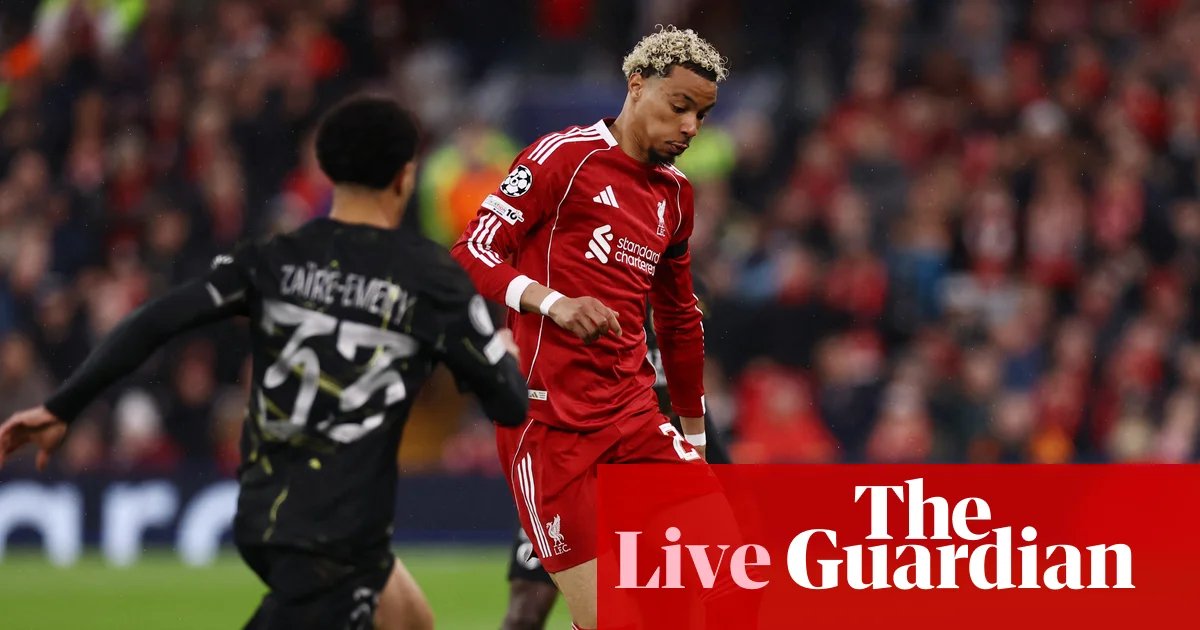
Key events
29 min A stretcher is being brought onto the field and Mo Salah is preparing to come on. There’s a fair bit of concern on the faces of both the Liverpool and PSG players.
28 min Ekitike is down and looks in a significant pain. It’s a rainy night at Anfield and he slipped with nobody near him. This doesn’t look great.
25 min Dembele’s excellent cross/pass from the right finds Doue in a peedie bit of space at the far post – but he decides to take a touch and leaves the ball behind. If he had the chance again he might wallop a first-time shot on the bounce.
There’s been another goal in Madrid. Here’s some bait. Would you like to click it?
22 min Safonov makes a fine one-on-one save from Isak, though the flag went up for offside after the event. Even so, that was more encouraging for Liverpool: a surge through midfield from Gravenberch and an Ian Rush-like run behind the defence from Isak.
20 min Kvaratskhelia is holding his coupon after a collision with Van Dijk’s stiff arm. It looked accidental.
19 min “Liverpool fans cheering half challenges that don’t quite win the ball back reminds me of Petey’s recital in American Pie 2,” writes Niall Mullen.
[NB: Clip may well contain adult themes and/or language. I mean, it’s three minutes long and it’s from American Pie 2, so there’s a fair chance.]
17 min: Big chance for Dembele! Somebody throws a second ball onto the pitch while PSG are exploring the Liverpool penalty area. Play continues and Joao Neves lobs a short pass into Dembele, whose shot on the turn from eight yards goes over the bar. The bounce made it slightly awkward but it was still the best chance of the game so far.
16 min A mishit volley from Gravenberch loops towards goal, not entirely unlike the famous Origi goal v Everton, and is punched away under pressure by Safonov.
14 min Frimpong’s overhit cross is collected on the far side by Kerkez. He twists Hakimi inside-out but then crosses straight into the hands of Safonov.
12 min A Liverpool goal would change the mood at a stroke, but right now PSG are bossing the game while apparently playing in second gear. Again, it might be recency bias but I’m not sure I’ve seen a better club side since Pep Guardiola’s Barcelona.
10 min Dembele curves a delicious through ball towards Zaire-Emery on the edge of the Liverpool area. Mamaradashvili slides at his feet to clear the danger – but only temporarily. The ball is collected by Dembele, who quickly shoots from 35 yards and draws an unorthodox save from Mamardashvili. He was running back towards the goalline and punched the ball away a little awkwardly. Inelegant but effective.
8 min Kvaratskhelia beats Frimpong without even touching the ball. It was rolled up to him near the halfway line, and in the blink of an eye he’d let it run through his own legs and away from Frimpong.
Nothing comes of it, but it’s another example of Kvaratskhelia’s lubricious ability. I can’t deal with this bloke. He shouldn’t be allowed to play football before the watershed.
6 min Wirtz wins Liverpool’s first corner of the game. Szoboszlai’s outswinger is met by Isak at the near post; his flicked header is comfortably by Safonov. Decent effort.
In other news, there’s been an early goal in Madrid.
4 min That corner eventually leads to Kvaratskhelia flashing a curler towards goal from 25 yards. Mamardashvili can’t hold the shot but has time to collect the rebound.
3 min PSG have made an ominously assured start. Kvaratskhelia gets to the byline, then cuts back and finds Zaire-Emery on the edge of the area. His whipped shot is headed behind for a corner.
2 min Liverpool have started with Florian Wirtz playing from the left. Looks like a 4-1-4-1 formation with Wirtz and Ekitike as the wide forwards.
1 min After a minute’s silence in memory of the 97 Liverpool fans who lost their lives at Hillsborough 37 years ago tomorrow, PSG get the game under way.
“Liverpool’s team selection,” begins Peter Oh, “is just the latest example of expecting too much of generative AI (Alexander Isak).”
“Thanks for posting Ian Copsestake’s very lovely and inspiring comment – and his book does look fascinating,” writes Philippa Bowe. “The comment echoed my recent thoughts, how the team is struggling so much in a season coloured by that terrible loss but still have to deliver those regular doses of escapism for the fans – and incur their wrath when they don’t quite manage. The beautiful game is so meaningful for so many people, it often feels like the players aren’t really allowed to be human.”
I agree. It might be recency bias but I can’t remember a time when football – or life – had such an empathy deficit.
Here come the players. The atmosphere is… well, it’s Anfield.
“You’d think after nearly two years in the job Slot would know the value of consistency by now?” writes Andrew Chappell. “But apparently he’s willing to roll the dice again with a new formation today. And letting the opposition know Isak is being subbed after 45 minutes? I’m doing my best to find reasons to be cheerful (part four) but not entirely feeling it…”
They’ve played this formation before, haven’t they, albeit with Salah rather than Isak in attack? Or have I been having more dreams about Liverpool FC?
The match is on Amazon Prime in the UK, which means we get to spend the evening with my favourite pundit, Clarence Seedorf. Here’s his take on the game.
It’s about how much the Liverpool players actually believe they can turn this around. We will see it in the first few minutes, in their eyes and in their actions.
To the victor belongs the spoils
Tonight’s winners will play Bayern Munich or Real Madrid in the semi-final, with the first leg at home on 28 or 29 April. The second leg is on 5 or 6 May.
“Hi Rob!” begins Joe Pearson. “‘If we can do it, wonderful. If not, then fail in the most beautiful way.’ With a nod to Jurgen Klopp, I have no expectations, only hope. Sigh.”
“Liverpool have been in a cloud of melancholy at times, having to get on with the day job of fulfilling dreams while suffering an acute loss with no time to mourn,” writes Ian Copsestake. “It used to be that such mental distress was treated with a sea journey. There’s even a new book about its history. But absurdly it is Liverpool who are tasked with lifting us, and on that voyage I wish them pure joy.”
Ian is too modest/English/English to add that he is the author of the book, Madness and the Sea, which looks fascinating.
When Warren Zaïre-Emery ran the show as a 17-year-old in a 3-0 win against Milan, Thierry Henry said “the sky is the limit” for the Paris Saint-Germain midfielder. His stratospheric rise led him too close to the sun, though, and the crash back down to Earth was a rude one. But he has since dusted himself off.
The players on a yellow card
-
Liverpool Van Dijk, Mac Allister, Gravenberch, Jones.
-
Paris Saint-Germain Nuno Mendes, Kvaratskhelia.
Arne Slot has said that Alexander Isak won’t be able to play much more than 45 minutes. Interesting. I guess the logic of starting him is that, if you bring him off the bench, the match could go to extra-time.

Sid Lowe
Luis García was “super cool”, he says. That, at least, was the plan, but things have a habit of working out differently. When the former Atlético Madrid, Barcelona and Liverpool player retired in 2016, it was the second time: he walked out of the game in 2014 and walked back in again six months later. But this time, he wasn’t going to be affected. All that suffering and satisfaction, the pressure, the emotion: that was no more.
“I was always very competitive and once I had left football, I thought I wasn’t going to have those feelings I had before,” he says. “I still enjoy football, still play seven-a-side with my friends – every Saturday at 10am, Los Jareños Club de Futbol – but I thought I had lost that and it wasn’t coming back. In fact, I was trying to avoid it; I didn’t want it. So when it happened, it surprised me. I didn’t expect football to give me that again. But there I was, crying.”
It was mid-February in Iskandar Puteri, Malaysia, and the players García was watching celebrating a historic win were his, the feeling shared. “When I saw them jumping with joy, having been with them every day, sharing the long journeys, from Malaysia to Vietnam and back, on to Japan, and then saw them win I got that emotion again.”
“Disappointed that Ngumoha isn’t starting,” writes Patrick Crumlish. “Played so well at weekend and has something most of the team are lacking – confidence.”
Yeah, I’d have started him, both for his obvious ability and the impact it would have on the crowd.
“There’s a strong argument that Liverpool were the better side in the first leg at Camp Nou in 2019,” writes Niall Mullen. “Certainly 3-0 massively flattered Barca. Unfortunately 2-0 to PSG a week ago massively flattered Liverpool and, I’d argue, this PSG team is better than the 2019 Barca team while this Liverpool team is considerably worse than that Liverpool team. Which all adds up to say that sometimes even magic nights at Anfield sometimes crash into the cold concrete wall of reality. I suspect this tie will be over well before half-time.”
That’s a great point about the first leg in Barcelona in 2019.
Tonight’s other quarter-final is in Madrid, where Atletico have a 2-0 aggregate lead over Barcelona. You can follow that with Will Unwin.
Team news: Isak starts
Alexander Isak starts a Liverpool game for the first time since December, replacing Joe Gomez in the only change from the first leg. Mo Salah and Rio Ngumoha, who scored against Fulham at the weekend, are on the bench.
PSG are unchanged, because why would you change that XI?
Liverpool (possible 4-D-2) Mamardashvili; Frimpong, Konate, Van Dijk, Kerkez; Gravenberch; Szoboszlai, Mac Allister; Wirtz; Isak, Ekitike.
Subs: Woodman, Misciur, Gomez, Jones, Chiesa, Salah, Robertson, Nyoni, Nallo, Ngumoha.
Paris Saint-Germain (4-3-3) Chevalier; Hakimi, Marquinhos, Pacho, Nuno Mendes; Zaire-Emery, Vitinha, Joao Neves; Doue, Dembele, Kvaratskhelia.
Subs: Chevalier, Marin, Lucas Beraldo, Zabarnyi, Goncalo Ramos, Lee, L Hernandez, Mayulu, Dro Fernandez, Barcola, Mbaye.
Referee Maurizio Mariani (Italy).

Andy Hunter
Arne Slot has said Liverpool do not face an impossible task against Paris Saint-Germain but must produce the perfect performance to overcome the European champions in the quarter-finals of the Champions League.
Liverpool require another stirring Anfield comeback in Tuesday’s second leg to salvage their hopes of silverware having lost 2-0 at Parc des Princes last week. PSG were vastly superior in the first leg and should have won more comfortably, although their head coach, Luis Enrique, described such talk as “a trap” and claimed there will be “pitfalls” for his team at Anfield.
Slot and Dominik Szoboszlai exuded confidence at the pre-match press conference on Monday, with the Liverpool head coach insisting it will not be difficult to instil belief in his players for a make-or-break night at Anfield.
Preamble
Right, where shall we start? Saint-Etienne 1977, perhaps, the first epic European comeback at Anfield. Maybe Auxerre 1991 or Dortmund 2016, when Liverpool made a mockery of apparently insurmountable deficits. “The stadium seemed to know what would happen,” winced Dortmund’s manager Thomas Tuchel after Dejan Lovren scored an injury-time winner. “It was as if it was meant to be.”
Barcelona 2019 is the ultimate, a 4-0 win with a weakened team that still blows the mind seven years on. Those precedents – and the knowledge that Anfield is a unique microclimate – are sources of hope for Liverpool as they strive for another glorious comeback against Paris Saint-Germain tonight.
There’s also a nagging fear that the only relevant precedent is last week’s first leg, when PSG ran Liverpool ragged and should have won by more than 2-0. Even the staunchest Kopite might concede that PSG are a class apart, and all logic says they will cruise into a semi-final against Bayern Munich and Real Madrid.
Oh, just one more thing: logic and European nights at Anfield don’t always see eye to eye.
Kick-off 8pm.
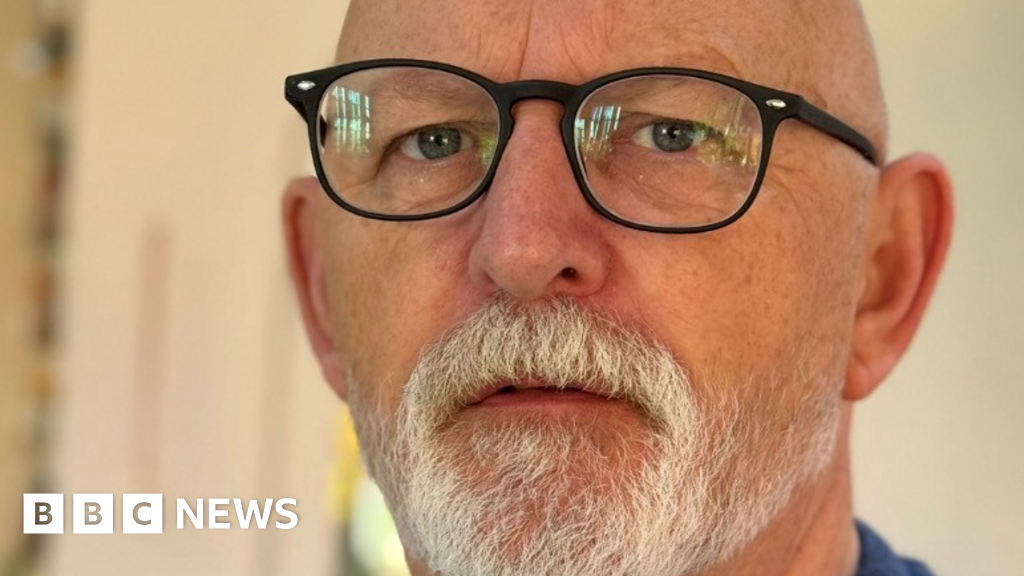
The family of Shaun Burton, say they are “devastated” by the loss.
Source link

Key events
In the opening half an hour against Cape Verde, Mikel Oyarzabal, the centre-forward, did not get a single touch.
Kyle Green gets in touch: “Your highlighting of Lalas and his absurdity is something that has prevented me from wanting to watch the coverage on Fox. While every channel has its pros and cons I just can’t.
“I’m 45 and probably the youngest of anyone who remembers him as a player instead of an opinionated insert insult here. As for the match this could be more competitive than it looks on paper Spain need a win the pressure is on them. Saudi Arabia could hold out for a draw and see what happens in their last match. “
News from the England camp, and it seems to be good news on Declan Rice.
“I’m ready and fit, raring to go. I was feeling a little bit of neural pain in my hamstring, which I was managing from after Christmas with Arsenal for a very long time. Obviously, not a lot of people would have known that. It was all behind-the-scenes stuff but it was a smart decision.
“In the end, that last 20 minutes is probably where you pick up the most, and it’s where you play a 70-minute match. But that last 20 is where you really feel your body going for it. And I think it was a smart decision because the last few days I felt really, really good.”
Alex Reid has penned today’s weekend special Football Daily.
Portugal v Uzbekistan on Tuesday enticingly pits the incredibly nice, incredibly 41-year-old-superstar-tolerant Roberto Martínez against Fabio Cannavaro, who’s won a Ballon d’Or as a player and the Chinese Super League as a coach. While the fixture following that game really does see the dream of Thomas Tuchel – in his first international job with England – taking on Queiroz, who is in charge of his ninth national side with Ghana.
The expected formations are 4-2-3-1 for Spain, and 5-3-2 for the Saudi Arabians.
The Saudi team features two Donis changes: Ali Lajami, a defender, and Nasser Al Dawsari, a midfielder, are preferred to Mohammed Abu Al Shamat and Mohamed Kanno. You may recall Salem Al Dawsari, the Saudi captain, as the man who scored the winner against Argentina.
An entertaining read, even for those of us who have just seen the clips.
In a conversation where his co-panelist is casually reminiscing about his days playing alongside Messi or exchanging shirts with Ronaldo Nazário at the World Cup, what exactly is Lalas going to talk about – coming on as a second-half substitute for Earnie Stewart in a friendly against Scotland in 1998? Helping the Kansas City Wizards finish last in the 1999 MLS Western Conference? Did Lalas enjoy an elite playing career? No. But does he do the background reading that could compensate for his relative lack of standing in a conversation with titans like Henry and Zlatan? Also no. But is he charming or funny or charismatic or otherwise magnetic on screen? Eh, no.
For the record, I once interviewed Alexi Lalas on the challenge of playing against Romario in the 1994 World Cup. He had this to say:
“He could kill you in so many different ways. If you remember from that World Cup, he scored so many types of goals. That ranged from solo adventures to an outside-of-the-right-foot half-volley off a corner kick. Romario was both the most difficult to play against and the best that I have faced.
“Roberto Baggio was doing his thing, but in terms of consistency and living up to the hype, he [Romario] was the best. As with all stars, there was a moment when the fans sit up in their seats, and that was a feeling I got with Romario. When it got close to him and the potential for his involvement in a play was there, everybody sat up in their seat. They knew that something spectacular would be happening.”
Saturday’s match reports here.
The Saudi Arabia coach, and Blackburn legend, Georgios Donis, spoke about the challenges facing his team: “Spain is not the same team when Yamal or Williams are on the bench.
“While they still have plenty of possession, they lack the individual one-on-one penetration when these two are missing. I’m not saying it’s a problem for Spain, but when those players are missing, they play in a different way. We saw this very clearly against Cape Verde.
“We are playing against one of the best teams in the world, and it’s very important that when you play against these kinds of teams, you should enjoy the experience and respect the opponent, but not too much.
“It is very hard for any team playing against Spain to have any time in possession. So what we must do is to be more in control of our movement and compact, and when the ball goes through the lines, be able to defend dynamically.
“It’s nice to see miracles in football, and we’ve seen favourites losing against underdogs. Of course, it’s great for Saudi football to have a great memory of the result against Argentina, but we aren’t drawing anything from that.
“I think we’ll feel more pressure in that [Cape Verde] game than we will against Spain.”
The Spain coach, Luis De La Fuente had this to say in his Saturday press conference: “This generation of footballers is highly competitive and really fired up… It’s going to be a completely different story,” he said at his pre-match press conference on Saturday. There is no drama or crisis. The bottom line is simply that we need to win tomorrow.”
Four changes for Spain: Lamine Yamal, Pedro Porro, Dani Olmo and Alex Baena also come into the side with Marcos Llorente, Fabian Ruiz, Ferran Torres and Gavi dropping out.
The teams – Lamine Yamal starts
Spain: Simon, Porro, Cubarsi, Laporte, Cucurella, Gonzalez, Rodri, Yamal, Olmo, Baena, Oyarzabal. Subs: Raya, Joan Garcia, Pubill, Grimaldo, Eric Garcia, Llorente, Merino, Torres, Fabian, Gavi, Pino, Williams, Zubimendi, Munoz, Iglesias.
Saudi Arabia: Al Owais, Abdulhamid, Tambakti, Lajami, Al Amri, Al Harbi, Nasser Al Dawsari, Al Khaibari, Al Juwayr, Al Buraikan, Salem Al Dawsari. Subs: Al Aqidi, Al Kassar, Majrashi, Yahya, Al Shehri, Al Boushal, Kadesh, Al Johani, Al Ghannam, Al Hajji, Al Hamdan, Mandash, Kanno, Thakri, Abu Al Shamat.
Referee: Raphael Claus (Brazil)
Perhaps one of the Saudi -players can write themselves into this high-grade selection?
Perhaps it can be their goalkeeper.
Madrid screening of Spain v Saudi Arabia cancelled due to heat
The public screening of Spain’s World Cup match against Saudi Arabia in Madrid on Sunday has been cancelled because of extreme heat forecast for the Spanish capital, officials said.
The match, due to kick off at 6pm local time on Sunday, had been scheduled to be shown on a giant screen installed by the Spanish football federation (RFEF) at a fan zone in Plaza de Colón in central Madrid.
Madrid city council and the federation decided to cancel the screening after national weather agency AEMET issued an orange heat warning – the second-highest level – for the Madrid region, with temperatures forecast to reach 40C.
“The decision has been taken with the aim of protecting the health of attendees, event staff and support services involved in the event,” Madrid city hall said in a statement, apologising for any inconvenience.
Officials urged supporters to watch the match indoors in air-conditioned spaces and avoid prolonged exposure to the heat.
Large parts of Spain are experiencing unusually high temperatures for June as a mass of hot air from North Africa moves across the Iberian Peninsula.
A total of 13 of Spain’s 17 regions are on orange alert for heat on Sunday, while the northern Basque Country bordering France is on red alert, the highest level.
Authorities advised residents and visitors to take precautions during the heatwave, including drinking water regularly, staying in cool environments, limiting outdoor physical activity during the hottest hours of the day and taking extra care of vulnerable people. AFP
Can Saudi Arabia repeat the magic of 2022?
Argentina arrived in Qatar on a 36-game unbeaten run. When Lionel Messi opened the scoring from the penalty spot after 10 minutes, a comfortable afternoon seemed in the offing. Saleh al-Shehri and Salem al-Dawsari had other ideas, Argentina had three goals disallowed for offside in the space of 13 minutes and the greatest comeback in Saudi Arabia football history was made. Argentina went on to lift the trophy, while defeats to Poland and Mexico meant the Saudis did not reach the knock-out stage.
Unai Simon over David Raya is a controversial choice for De la Fuentes. The Arsenal keeper could lay claim to being Europe’s best this season.
“Those at the Champions League final had a few more days, so I got there on the Wednesday night,” Raya says. “I arrived a bit before Fabián [Ruiz]. I was saying hello to some of the others in reception when he arrived. I went to say congratulations; that was almost the first thing I did. I couldn’t really talk [to him] after the final; I just didn’t have it in me. The next day we talked about the game properly. Just two mates chatting … I was happy for him that he could lift the trophy for a second time.”
A high pressure game for the European champions, as Sid Lowe reports.
“If we had scored one, the game would have changed,” Martín Zubimendi said. Immediately after the game, De la Fuente had offered a simple analysis: when the ball doesn’t want to go in it doesn’t want to go in, he insisted. Spain had racked up 27 shots, after all. Ferran Torres had hit the bar and seen another clear opportunity saved. Vozinha, the 40-year-old goalkeeper who stopped that, saved six more and was named the man of the match. “There’s nothing to reproach the team for,” Rodri said. “We generated chances but couldn’t put it away; the good thing is they created almost nothing.”
We wait to see what role Lamine Yamal will play today. His coach would surely like to be able to use him.
The worst mistake we could make would be to compare him to anyone. He is the midst of a process. He has exceptional footballing maturity and lives it all with total naturalness. He has great serenity and strength. We have to let him follow his path but those players who have something different are ready for that. They’re geniuses, like Dalí [who] can paint a picture, or Michelangelo. They’re different. What is exceptional to us, isn’t to them. In those extremes, they feel comfortable. Why? Because they are different. What we think is exceptional, they consider normal.
Preamble
Spain’s campaign did not get off to a flying start, and Luis de la Fuentes may wake up in the night to visions of Cape Verde’s Vozinha. He will have Georgia on his mind ever since Monday. Saudi Arabia are no pushovers and gave Uruguay a scare in their opening match. Memories of downing Argentina four years ago still abound, and so Spain might beware. They can ill afford to go into the final game with Uruguay at a disadvantage. All eyes on Lamine Yamal, whose fitness situation remains opaque, though Spain need their other forwards to come to the party.
Kick-off 5pm UK, 1pm ET, 2am AEST. Join me.

A topless man can be seen driving erratically in Edinburgh before abandoning his car and attacking a black man and a delivery rider.
Source link



-

 Oxford University4 weeks ago
New to the Oxford English Dictionary this September
-

 Oxford united FC4 weeks ago
Chris Gunter steps away Wales role to focus on Oxford United
-

 Oxford united FC2 weeks ago
LIVE: Exeter City vs Oxford United – Jersey Mike's Trophy group stage
-

 Traffic & Transport3 weeks ago
Why should I have to pay more for buses if I don’t use a smartphone? | Bus fares
-

 Traffic & Transport3 weeks ago
How poor public transport policy is putting the brake on cities | Road transport
-
 Student Life3 weeks ago
Oxford partnership allows OpenAI to use rare Bodleian texts to train ChatGPT
-

 Oxford united FC2 weeks ago
Oxford United lose to Exeter City on penalties in Jersey Mike’s Trophy
-

 Oxford united FC3 weeks ago
Northern Ireland fans laud Oxford United defender Ciaron Brown