
UK News
Hungary election live: voters head to the polls in contest that could see end of Viktor Orbán’s rule | Hungary

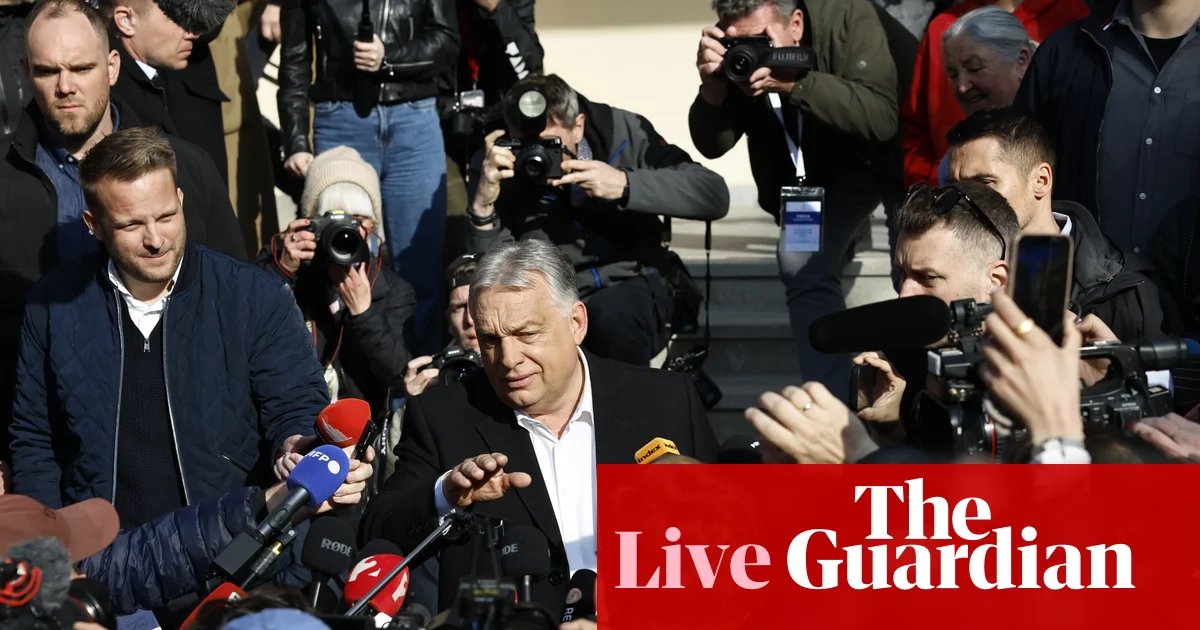
Key events
Good ‘vibes’ give Budapest hopes for opposition win

Jakub Krupa
in Budapest’s 14th district
Making the most of a beautiful day in Budapest, I spent a large part of the day zooming Budapest (using the city’s great bike paths!) and chatting with voters.
In the 14th district of Budapest, I spoke with several people voting in the polling stations on Ajtósi Dürer sor.
Atilla, 35, told me that he was confident about the result because of “the vibes” in the city and the country. “It will be really big change,” he told me confidently.
But where was that confidence coming from, I ask. “[It’s] because of the vibes in Hungary,” he replied with a cheeky smile. “It’s the vibes, [everyone is] so passionate, and I’m hearing it’s not just in Budapest, like four years ago; it’s better.”
How much a potential change of government would mean to him?
No words to say how much. Too much.
Separately, Barbara and Margit, 21, also expressed some hope about the result – but they struck a more cautious note.
“I feel really hopeful. We finally have a chance to change the government,” Margit said.
But Barbara said she wanted to stay “realistic” before the results come in.
“I thought last time around that the opposition seemed pretty strong and it wasn’t [in the end]. I’m trying to not get my hopes up, but we will see. I hope something changes today.”
She added that if the opposition wins,
“It will mean a lot – not just for us as a country, but also for Europe in general. I have seen quite a few posts about the Czech Republic and different countries, all waiting for [the results of] our election.”
Voters in Budapest for change, but remain nervous about outcome
Flora Garamvolgyi
in Budapest’s 5th district
I went to a few polling stations today to get a sense of how Budapest residents in the heart of the city are feeling about today’s elections.
Most of them weren’t sure about the outcome, despite most polls showing a confident lead for Tisza, but expressed hope. Some young voters said they feel like they are witnessing a historic moment.
“I really hope there will be a change of government,” Fruzsi, 22, told me at Erzsébet Square, next to the famous Budapest ferris wheel, right after she cast her vote. “My experience is that there are so many angry people because they are lying to us.”
She says she is really bothered by the intense propaganda the government is pushing on voters.
Gergő, 36, seemed a little more nervous about the results. He said he and others anticipated change during previous elections, too, and were unpleasantly surprised by the outcome. So now he is more cautious and approaches today with an “anything is possible” attitude.
“But I am anticipating change. At least I’m hoping. … This arrogant political style from the government, and that they are inciting hate and attacking everyone, from teachers to judges and all ethnic groups, is awful,” he told me, adding that when the government is done with attacking Zelenskyy, they’ll find a new enemy.
Mária, 81, is also hopeful, but she is hoping for a very different outcome than Fruzsi and Gergő, rooting for the ruling party, Viktor Orbán’s Fidesz.
“I trust that he’ll protect our country,” she told me, adding that she doesn’t think the war is the biggest threat looming over Hungary, but rather “all of these extremist people who don’t think the way they should.” She said people should not have too high expectations for the government because they don’t have the budget to execute everything, and is hopeful that it’ll be another supermajority for Orbán.
I am now heading over to the international press room at the Tisza event – after making sure I’m properly caffeinated for the long night ahead…
‘It’s going to be very exciting’ – what voters tell us on the ground in Budapest
in Budapest
Orbán’s Hungary ‘remains in a category of its own’ on repressive laws and policies
So much focus on Hungary is somewhat understandable as a recent Liberties report found that Orbán’s Hungary “remains in a category of its own [in Europe], continuing to pursue ever more regressive laws and policies with no sign of change”.
But it’s not the only country with severe problems when it comes to the rule of law.
Drawing on evidence from more than 40 NGOs in 22 countries, the Civil Liberties Union for Europe (Liberties) described the governments of Bulgaria, Croatia, Hungary, Italy and Slovakia as “dismantlers” that were actively weakening the rule of law.
But we also looked at the rule of law more broadly…
… as well as the far-right’s attacks on Europe’s public service media …
… and on how Europe’s civil society fights back against some of these controversial moves across the continent.
The report was prepared by our Europe correspondent Jon Henley, with contributions from Deborah Cole in Berlin, Angela Giuffrida in Rome, and, well, me!
‘He cares about Hungarians’: the small Ukrainian town divided over Orbán

Pjotr Sauer
in Berehove
Across much of Ukraine, Sunday’s parliamentary election in Hungary is being followed with a singular hope: that Viktor Orbán, the Kremlin-friendly leader who has made opposition to Kyiv a centrepiece of his campaign, will be voted out after 16 years in office.
But in Berehove, the mood is more complicated.
In this small town of about 30,000 in Ukraine’s hilly Zakarpattia region, ethnic Hungarians form a majority, and Hungarian is heard as often as Ukrainian. Daily life – from schooling to the television channels watched at home – remains closely tethered to neighbouring Hungary.
Some residents admit, often quietly, that they are rooting for Orbán’s Fidesz party.
Orbán has long portrayed himself as a defender of ethnic Hungarians abroad – about 60,000 of whom live in Zakarpattia – claiming they face widespread discrimination in Ukraine and are being forced to assimilate into Ukrainian society.
His critics, both in Hungary and within Ukraine, say he has exaggerated – and at times distorted – those grievances to justify a hostile stance towards Kyiv and its western allies.
Hungary’s Viktor Orbán seeking to drum up votes by doing down Ukraine
Ashifa Kassam and Flora Garamvölgyi
in Budapest
Paid for by its rightwing, populist government, the billboards attacking Ukraine’s Volodymyr Zelenskyy and the opposition leader, Péter Magyar, blanket Hungary.
It’s a nod to the election strategy that Viktor Orbán, the EU’s longest-serving leader, has unleashed as he lags in most polls before upcoming elections: convincing voters that the country’s greatest threat is not fraying social services, the rising cost of living or economic stagnation, but rather the neighbouring country of Ukraine.
“Effectively, Ukraine is portrayed as a main enemy,” said Zsuzsanna Végh, an analyst at the German Marshall Fund. “This is not just about Ukraine per se, but it fits into the standard strategy of the governing party, of mobilising its electorate through generating fear in society.”
In 2018, when Orbán was seeking a third consecutive term as prime minister, he and his Fidesz party sought to stoke fears about migration. In 2022, as voters headed to the ballot box five weeks after Russia launched its full-scale invasion of Ukraine, Orbán peddled the baseless claim that the opposition would send Hungarian troops to fight in the war.
This election, as Orbán faces an unprecedented challenge from a former top member of his own party, Péter Magyar, the strategy has seemingly been kicked into high gear. “We definitely see a significant escalation,” said Végh.
Leaked calls prompt scrutiny of Hungary’s close ties with Moscow
In the final weeks of the campaign, Viktor Orbán and his ministers also repeatedly clashed with Ukraine and EU member states over Budapest’s close ties with Moscow.
In one leaked phone call, it appeared that Orbán offered to go to great lengths to help Vladimir Putin, telling the Russian leader “I am at your service” in an October call, it has emerged, prompting further scrutiny of Budapest’s ties to the Kremlin just as JD Vance arrived in the city.
Separately, a number of leaked telephone calls between Hungary’s foreign minister Péter Szijjártó and his Russian counterpart, Sergei Lavrov, prompted the European Commission to demand an urgent explanation from Budapest.
In the leaked conversations, the pair talked about a number of confidential EU discussions, including on EU sanctions on Russia and the bloc’s accession policy towards Ukraine, with Szijjártó even offering to share some internal documents.
Their interactions were branded “repulsive” and “unacceptable” by several EU leaders.
In response, one of the country’s best-known investigative journalists was also targeted by the government with spying allegations.
Trump, Vance and European far-right leaders rallied for Orbán ahead of tricky electoral test
In the build up to today’s vote, Hungary’s Viktor Orbán received unprecedented backing from foreign leaders, many of whom even made the trip to Budapest to offer their public endorsement.
In late March, several like-minded leaders from across Europe – including France’s Marine Le Pen and the Netherlands’ Geert Wilders – attended a “Patriots for Europe” meeting in Budapest, praising the embattled prime minister and his importance in the conservative movement.
And in the last week, the US vice-president JD Vance flew into Budapest to appear alongside Orbán and endorse him just days before the vote.
“It’s unprecedented for an American vice-president to come the week before an election,” he acknowledged.
But he said he had decided to come because of what he described as the “garbage happening against” Orbán in the election, and said he wanted “to help, as much as I possibly can” – all while rejecting claims of interference.
But his boss, the US president, Donald Trump, has also not exactly been shy about expressing his preferences, repeatedly urging Hungarians to vote for his ideological ally.
On Friday, he even offered to throw “the full economic might of the US to strengthen Hungary’s economy,” stepping up his support for Orbán even further.
Who is Péter Magyar, the opposition leader challenging Viktor Orbán?
Ashifa Kassam and Flora Garamvölgyi
in Budapest
As a child growing up in Budapest, Péter Magyar had a poster of Viktor Orbán – at the time a leading figure in the country’s pro-democracy movement – hanging above his bed.
Orbán was one of several political figures that adorned his bedroom, Magyar told a podcast last year, hinting at his excitement over the changes sweeping the country after the collapse of communism.
Now Magyar, 45, is the driving force behind what could be another momentous political change in Hungary: the ousting of Orbán, whose 16 years in power has transformed the country into a “petri dish for illiberalism”.
Conversations with those who know Magyar often alternate between admiration and antipathy. Many praise the tremendous movement he has built and the discipline he has shown as he crisscrosses the country, giving up to six speeches a day, while also describing him as someone with a short temper and a style that can be abrasive at times.
Others see him as the perfect fit for the magnitude of the moment. “I think, like all politicians, he can be a difficult person,” said Tamás Topolánszky, a film-maker who was part of a team that spent the past 18 months following Magyar for a film on the wider change sweeping Hungarian society.
Topolánszky described Magyar as authentic and passionate, but also someone who could be impatient at times. “I think that this is something that we Hungarians now see was necessary to get us to this point.”
Opposition leader Magyar paints vote as ‘choice between East or West’
Opposition leader Péter Magyar said today’s vote in Hungary amounted to “a choice between East or West” which would define the country’s future for “a very, very long time.”
Speaking to reporters after voting in Budapest, Magyar presented the vote as a historic choice of the country’s orientation and between “propaganda or honest public discourse; corruption or clean public life.”
He said first turnout data was “very, very encouraging,” but urged everyone to vote.
The fate of Hungary is being decided today for a very, very long time.
The Tisza leader appeared confident about the result of the vote, saying his party “will win this election,” but “the question is whether we can get this two-thirds mandate, or do we have to govern with a simple majority.”
He said a supermajority would make it easier to “dismantle this system, tear apart this spider web which entangles our country.”
Magyar also responded to speculations about potential provocations that could see the result contested, urging people to “maintain their peace.”
“No one should give in to any provocation. We know for sure that if this election takes place calmly and legally, then this election will be won by Tisza and Hungary,” he said.
2026 turnout by 5pm still far ahead of previous elections
Speaking about the turnout (17:20), we have just had the latest update, showing record-high levels of interest in the election.
More than 74% of the electorate has cast their votes by 5pm, up from 62% at the same time of the day in 2022.
Most Hungarians want better relations with EU, poll finds

Jon Henley
Europe correspondent
After years of relentless EU-bashing by their nationalist, illiberal prime minister, an overwhelming majority of Hungary’s voters back its membership of the bloc, and most – including many of Viktor Orbán’s voters – now want a new approach to Brussels.
Days before elections at which Orbán, who has consistently painted the EU as an enemy of the Hungarian people, risks being ousted after 16 years in power, a poll has shown a huge appetite for a recalibration of the country’s relations with the bloc.
The survey, by the European Council on Foreign Relations (ECFR) thinktank, found that 77% of voters support EU membership; three-quarters of respondents “trust” the bloc; and 68% want at least some degree of change in Hungary’s EU engagement.
Orbán has battled with Brussels – which has suspended billions of euros in funding – over a wide range of policies including on justice, migration, LGBTQ+ rights and aid for Ukraine, which, along with sanctions against Russia, he has consistently blocked.
EU leaders have largely steered clear of commenting on Sunday’s vote to avoid accusations of seeking to influence it, but Orbàn’s status as a far-right icon in Europe and beyond makes the election the bloc’s most consequential this year.
While the desire for change was strongest (91%) among supporters of Péter Magyar, the centre-right challenger whose Tisza party leads Orbán’s Fidesz by a double-digit margin in recent polls, nearly half (45%) of Fidesz voters also wanted a reset.
Majorities of Fidesz voters also said they supported Hungary’s continued membership of the EU (65%) and “trusted” the bloc (64%), while a large minority (43%, compared with 66% in the population as a whole) even backed Hungary joining the euro.
23 years on from EU accession referendum, Hungary ‘once again … decides direction’ of country
Ashifa Kassam and Flora Garamvölgyi
in Budapest
Today’s election comes 23 years to the day after Hungarians voted overwhelmingly to join the European Union, drawing comparisons to that historic vote and its influence on the future of the country.
“Now, on 12 April, once again, voters are not simply choosing between parties, but deciding the direction, identity, and future of Hungary,” Tisza’s Anita Orbán, no relation to the prime minister, said on social media. “In many ways, this election is a referendum on whether Hungary returns to European values.”
It was a hint of how much has changed in Hungary since Orbán took power in 2010. What followed was, in the words of Zoltán Kész, a former member of the Fidesz party, nothing less than a “coup in slow motion,” albeit one that eschewed tanks for lawyers and clientelism.
The rightwing populist government had used its time in office to steadily whittle away at the checks and balances that constrained its power: rewriting election laws to its own benefit, manoeuvring to put loyalists in control of an estimated 80% of the country’s media, and retooling the country’s judiciary.
Meanwhile, Budapest has become a hub of thinktanks and conferences aimed at amplifying the idea of Hungary, in the words of one local journalist, as a “Christian conservative Disneyland” where the global far right feels at home.
The family of Shaun Burton, say they are “devastated” by the loss.
Source link

Key events
In the opening half an hour against Cape Verde, Mikel Oyarzabal, the centre-forward, did not get a single touch.
Kyle Green gets in touch: “Your highlighting of Lalas and his absurdity is something that has prevented me from wanting to watch the coverage on Fox. While every channel has its pros and cons I just can’t.
“I’m 45 and probably the youngest of anyone who remembers him as a player instead of an opinionated insert insult here. As for the match this could be more competitive than it looks on paper Spain need a win the pressure is on them. Saudi Arabia could hold out for a draw and see what happens in their last match. “
News from the England camp, and it seems to be good news on Declan Rice.
“I’m ready and fit, raring to go. I was feeling a little bit of neural pain in my hamstring, which I was managing from after Christmas with Arsenal for a very long time. Obviously, not a lot of people would have known that. It was all behind-the-scenes stuff but it was a smart decision.
“In the end, that last 20 minutes is probably where you pick up the most, and it’s where you play a 70-minute match. But that last 20 is where you really feel your body going for it. And I think it was a smart decision because the last few days I felt really, really good.”
Alex Reid has penned today’s weekend special Football Daily.
Portugal v Uzbekistan on Tuesday enticingly pits the incredibly nice, incredibly 41-year-old-superstar-tolerant Roberto Martínez against Fabio Cannavaro, who’s won a Ballon d’Or as a player and the Chinese Super League as a coach. While the fixture following that game really does see the dream of Thomas Tuchel – in his first international job with England – taking on Queiroz, who is in charge of his ninth national side with Ghana.
The expected formations are 4-2-3-1 for Spain, and 5-3-2 for the Saudi Arabians.
The Saudi team features two Donis changes: Ali Lajami, a defender, and Nasser Al Dawsari, a midfielder, are preferred to Mohammed Abu Al Shamat and Mohamed Kanno. You may recall Salem Al Dawsari, the Saudi captain, as the man who scored the winner against Argentina.
An entertaining read, even for those of us who have just seen the clips.
In a conversation where his co-panelist is casually reminiscing about his days playing alongside Messi or exchanging shirts with Ronaldo Nazário at the World Cup, what exactly is Lalas going to talk about – coming on as a second-half substitute for Earnie Stewart in a friendly against Scotland in 1998? Helping the Kansas City Wizards finish last in the 1999 MLS Western Conference? Did Lalas enjoy an elite playing career? No. But does he do the background reading that could compensate for his relative lack of standing in a conversation with titans like Henry and Zlatan? Also no. But is he charming or funny or charismatic or otherwise magnetic on screen? Eh, no.
For the record, I once interviewed Alexi Lalas on the challenge of playing against Romario in the 1994 World Cup. He had this to say:
“He could kill you in so many different ways. If you remember from that World Cup, he scored so many types of goals. That ranged from solo adventures to an outside-of-the-right-foot half-volley off a corner kick. Romario was both the most difficult to play against and the best that I have faced.
“Roberto Baggio was doing his thing, but in terms of consistency and living up to the hype, he [Romario] was the best. As with all stars, there was a moment when the fans sit up in their seats, and that was a feeling I got with Romario. When it got close to him and the potential for his involvement in a play was there, everybody sat up in their seat. They knew that something spectacular would be happening.”
Saturday’s match reports here.
The Saudi Arabia coach, and Blackburn legend, Georgios Donis, spoke about the challenges facing his team: “Spain is not the same team when Yamal or Williams are on the bench.
“While they still have plenty of possession, they lack the individual one-on-one penetration when these two are missing. I’m not saying it’s a problem for Spain, but when those players are missing, they play in a different way. We saw this very clearly against Cape Verde.
“We are playing against one of the best teams in the world, and it’s very important that when you play against these kinds of teams, you should enjoy the experience and respect the opponent, but not too much.
“It is very hard for any team playing against Spain to have any time in possession. So what we must do is to be more in control of our movement and compact, and when the ball goes through the lines, be able to defend dynamically.
“It’s nice to see miracles in football, and we’ve seen favourites losing against underdogs. Of course, it’s great for Saudi football to have a great memory of the result against Argentina, but we aren’t drawing anything from that.
“I think we’ll feel more pressure in that [Cape Verde] game than we will against Spain.”
The Spain coach, Luis De La Fuente had this to say in his Saturday press conference: “This generation of footballers is highly competitive and really fired up… It’s going to be a completely different story,” he said at his pre-match press conference on Saturday. There is no drama or crisis. The bottom line is simply that we need to win tomorrow.”
Four changes for Spain: Lamine Yamal, Pedro Porro, Dani Olmo and Alex Baena also come into the side with Marcos Llorente, Fabian Ruiz, Ferran Torres and Gavi dropping out.
The teams – Lamine Yamal starts
Spain: Simon, Porro, Cubarsi, Laporte, Cucurella, Gonzalez, Rodri, Yamal, Olmo, Baena, Oyarzabal. Subs: Raya, Joan Garcia, Pubill, Grimaldo, Eric Garcia, Llorente, Merino, Torres, Fabian, Gavi, Pino, Williams, Zubimendi, Munoz, Iglesias.
Saudi Arabia: Al Owais, Abdulhamid, Tambakti, Lajami, Al Amri, Al Harbi, Nasser Al Dawsari, Al Khaibari, Al Juwayr, Al Buraikan, Salem Al Dawsari. Subs: Al Aqidi, Al Kassar, Majrashi, Yahya, Al Shehri, Al Boushal, Kadesh, Al Johani, Al Ghannam, Al Hajji, Al Hamdan, Mandash, Kanno, Thakri, Abu Al Shamat.
Referee: Raphael Claus (Brazil)
Perhaps one of the Saudi -players can write themselves into this high-grade selection?
Perhaps it can be their goalkeeper.
Madrid screening of Spain v Saudi Arabia cancelled due to heat
The public screening of Spain’s World Cup match against Saudi Arabia in Madrid on Sunday has been cancelled because of extreme heat forecast for the Spanish capital, officials said.
The match, due to kick off at 6pm local time on Sunday, had been scheduled to be shown on a giant screen installed by the Spanish football federation (RFEF) at a fan zone in Plaza de Colón in central Madrid.
Madrid city council and the federation decided to cancel the screening after national weather agency AEMET issued an orange heat warning – the second-highest level – for the Madrid region, with temperatures forecast to reach 40C.
“The decision has been taken with the aim of protecting the health of attendees, event staff and support services involved in the event,” Madrid city hall said in a statement, apologising for any inconvenience.
Officials urged supporters to watch the match indoors in air-conditioned spaces and avoid prolonged exposure to the heat.
Large parts of Spain are experiencing unusually high temperatures for June as a mass of hot air from North Africa moves across the Iberian Peninsula.
A total of 13 of Spain’s 17 regions are on orange alert for heat on Sunday, while the northern Basque Country bordering France is on red alert, the highest level.
Authorities advised residents and visitors to take precautions during the heatwave, including drinking water regularly, staying in cool environments, limiting outdoor physical activity during the hottest hours of the day and taking extra care of vulnerable people. AFP
Can Saudi Arabia repeat the magic of 2022?
Argentina arrived in Qatar on a 36-game unbeaten run. When Lionel Messi opened the scoring from the penalty spot after 10 minutes, a comfortable afternoon seemed in the offing. Saleh al-Shehri and Salem al-Dawsari had other ideas, Argentina had three goals disallowed for offside in the space of 13 minutes and the greatest comeback in Saudi Arabia football history was made. Argentina went on to lift the trophy, while defeats to Poland and Mexico meant the Saudis did not reach the knock-out stage.
Unai Simon over David Raya is a controversial choice for De la Fuentes. The Arsenal keeper could lay claim to being Europe’s best this season.
“Those at the Champions League final had a few more days, so I got there on the Wednesday night,” Raya says. “I arrived a bit before Fabián [Ruiz]. I was saying hello to some of the others in reception when he arrived. I went to say congratulations; that was almost the first thing I did. I couldn’t really talk [to him] after the final; I just didn’t have it in me. The next day we talked about the game properly. Just two mates chatting … I was happy for him that he could lift the trophy for a second time.”
A high pressure game for the European champions, as Sid Lowe reports.
“If we had scored one, the game would have changed,” Martín Zubimendi said. Immediately after the game, De la Fuente had offered a simple analysis: when the ball doesn’t want to go in it doesn’t want to go in, he insisted. Spain had racked up 27 shots, after all. Ferran Torres had hit the bar and seen another clear opportunity saved. Vozinha, the 40-year-old goalkeeper who stopped that, saved six more and was named the man of the match. “There’s nothing to reproach the team for,” Rodri said. “We generated chances but couldn’t put it away; the good thing is they created almost nothing.”
We wait to see what role Lamine Yamal will play today. His coach would surely like to be able to use him.
The worst mistake we could make would be to compare him to anyone. He is the midst of a process. He has exceptional footballing maturity and lives it all with total naturalness. He has great serenity and strength. We have to let him follow his path but those players who have something different are ready for that. They’re geniuses, like Dalí [who] can paint a picture, or Michelangelo. They’re different. What is exceptional to us, isn’t to them. In those extremes, they feel comfortable. Why? Because they are different. What we think is exceptional, they consider normal.
Preamble
Spain’s campaign did not get off to a flying start, and Luis de la Fuentes may wake up in the night to visions of Cape Verde’s Vozinha. He will have Georgia on his mind ever since Monday. Saudi Arabia are no pushovers and gave Uruguay a scare in their opening match. Memories of downing Argentina four years ago still abound, and so Spain might beware. They can ill afford to go into the final game with Uruguay at a disadvantage. All eyes on Lamine Yamal, whose fitness situation remains opaque, though Spain need their other forwards to come to the party.
Kick-off 5pm UK, 1pm ET, 2am AEST. Join me.

A topless man can be seen driving erratically in Edinburgh before abandoning his car and attacking a black man and a delivery rider.
Source link



-

 Oxford University4 weeks ago
New to the Oxford English Dictionary this September
-

 Oxford united FC4 weeks ago
Chris Gunter steps away Wales role to focus on Oxford United
-

 Oxford united FC2 weeks ago
LIVE: Exeter City vs Oxford United – Jersey Mike's Trophy group stage
-

 Traffic & Transport2 weeks ago
Why should I have to pay more for buses if I don’t use a smartphone? | Bus fares
-
 Traffic & Transport3 weeks ago
How poor public transport policy is putting the brake on cities | Road transport
-

 Student Life3 weeks ago
Oxford partnership allows OpenAI to use rare Bodleian texts to train ChatGPT
-

 Oxford united FC2 weeks ago
Oxford United lose to Exeter City on penalties in Jersey Mike’s Trophy
-

 Oxford united FC3 weeks ago
Northern Ireland fans laud Oxford United defender Ciaron Brown